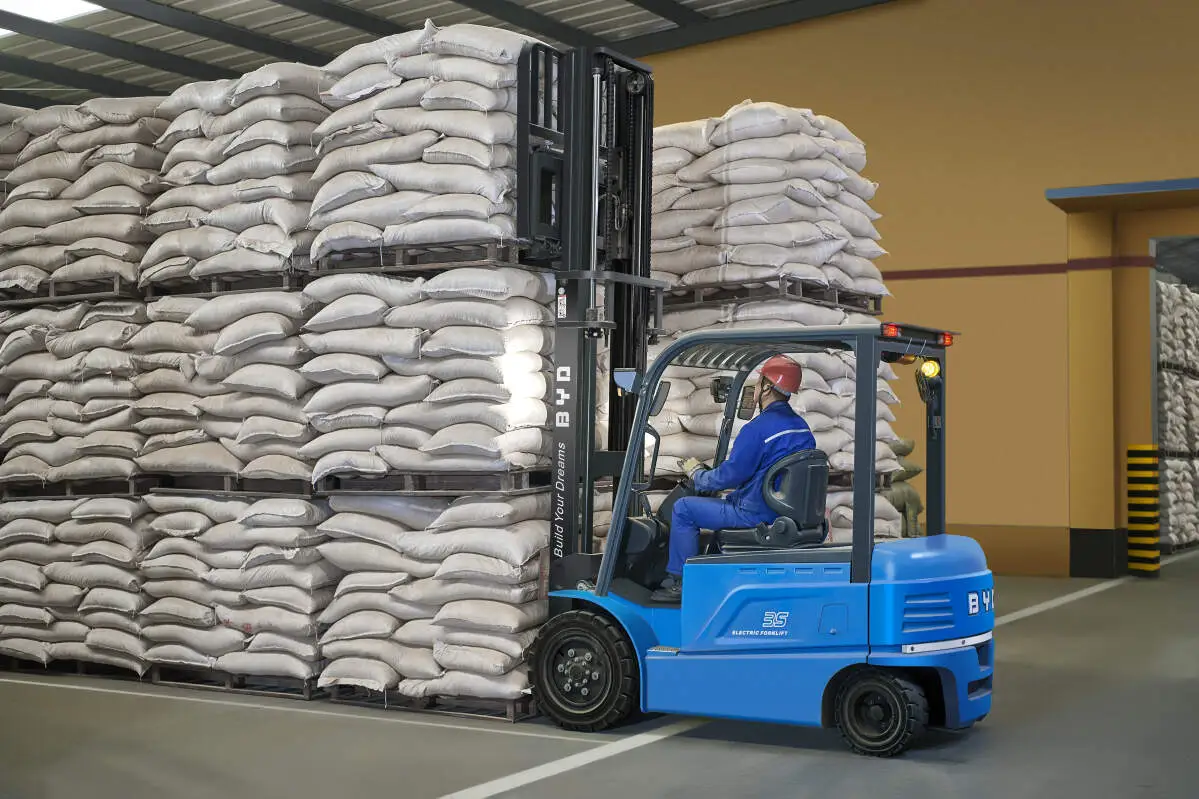
The forklift mast is a critical component that directly influences a forklift’s lifting performance, determining both how high loads can be raised and how much weight can be safely carried at different heights. Understanding the various mast types and their lifting capacity profiles is essential for selecting the right forklift to match specific material handling needs.
Standard masts are the most basic and compact mast configuration, typically consisting of one or two fixed sections. Designed for low-level lifting tasks, they offer maximum lifting heights ranging from 3 to 4 meters. Their lifting capacity remains relatively consistent across their operating height range, usually between 1 to 5 tons, with minimal reduction as the mast extends. This stability makes them ideal for small warehouses, retail stockrooms, or operations where loads are stored on ground-level or low shelves. Their compact size also enhances maneuverability in tight spaces, allowing easy navigation through narrow aisles.
Two-stage masts feature an outer fixed section and an inner movable section that slides upward to extend the lifting height. This design enables maximum lifting heights between 6 to 8 meters, making them suitable for medium-level storage systems. At full retraction, two-stage masts deliver their highest lifting capacity, which gradually decreases as the mast extends to its maximum height. The capacity reduction is moderate compared to more complex mast types, balancing higher reach with reliable load-bearing ability. They are widely used in medium-sized warehouses and distribution centers where a mix of low and medium shelf access is required.
Three-stage masts are built with three telescoping sections, allowing them to reach maximum lifting heights of 10 meters or more. This extended reach makes them the go-to choice for high-rise storage facilities, such as large logistics hubs and automated warehouses. However, their lifting capacity profile shows a more noticeable decrease with height: at full retraction, they can carry heavy loads similar to two-stage masts, but as the mast extends to its highest point, the allowable load drops significantly. Operators must closely adhere to capacity charts to ensure safe operation at different heights, as exceeding the rated capacity at elevated levels can compromise stability and safety.
When selecting a forklift mast type, it’s important to evaluate factors like required lifting height, typical load weight, warehouse layout, and operational frequency. Matching the mast type to these factors ensures optimal efficiency, safety, and longevity of the forklift in daily operations.