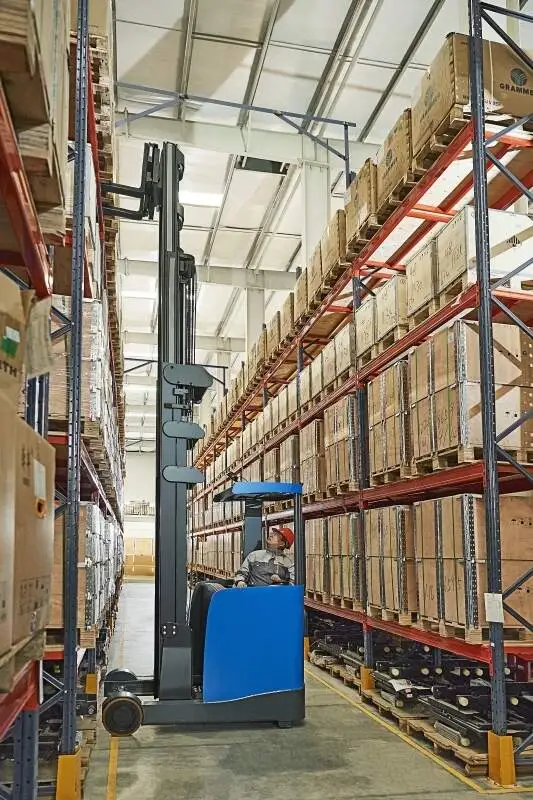
Warehouse operations rely heavily on selecting the right forklift type aligned with specific layout characteristics, as mismatched equipment can hinder efficiency and safety. Below is a breakdown of key forklift types and their tailored features for different warehouse setups.
For narrow aisle warehouses where space is at a premium and aisle widths are restricted, narrow aisle electric forklifts stand out with their compact, streamlined design. These models boast a tight turning radius, allowing seamless navigation through tight spaces without compromising maneuverability. Equipped with efficient electric motors, they produce minimal noise and zero emissions, making them ideal for indoor environments. Their vertical lift capabilities also support access to mid-level storage racks, maximizing vertical space use while ensuring precise load handling.
Open storage areas, characterized by wide aisles and large unobstructed spaces, benefit from counterbalance electric forklifts. These forklifts feature a heavy rear counterweight, eliminating the need for additional support structures and providing excellent stability when lifting heavy loads. With robust load capacities, they can handle bulky items and transport goods across long warehouse distances. Their user-friendly controls and extended battery life ensure continuous operation, reducing downtime during peak working hours.
High-rack storage facilities, designed to maximize vertical space with tall shelving units, require forklifts with advanced reach capabilities. Reach electric forklifts are engineered with extendable fork carriages that can reach deep into racking systems, enabling access to high-level storage positions. Their compact frame allows operation in moderately sized aisles, while precision controls ensure accurate load placement, minimizing risk of damage to goods and racking. Additionally, their electric power source supports clean, quiet operation suitable for indoor high-rack environments.
Cold storage warehouses, with low-temperature conditions that impact equipment performance, demand specialized cold-resistant electric forklifts. These models are built with insulated components and heated control systems to prevent freezing of critical parts, ensuring reliable operation in sub-zero temperatures. Their batteries maintain consistent performance in cold environments, avoiding rapid power depletion. Sealed components also protect internal systems from moisture and frost, extending the forklift's service life in harsh cold storage settings.
When selecting a forklift, evaluate factors such as aisle width, storage height, load capacity and environmental conditions to match equipment to the warehouse layout, optimizing material handling operations and ensuring workplace safety.