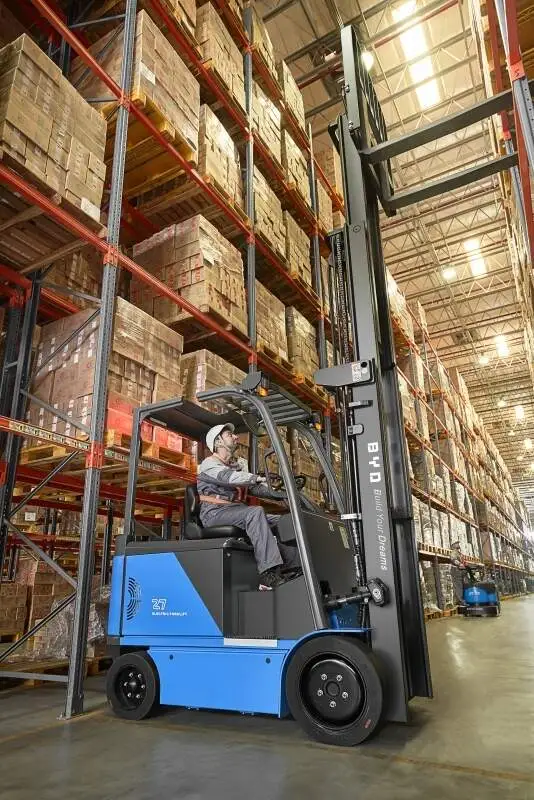
Proper narrow-aisle warehouse planning is one of the most cost-effective ways to raise total storage capacity for logistics and manufacturing sites, while ignoring forklift turning radius matching in early planning often leads to frequent shelf collisions, unsmooth operation paths and unnecessary space waste. This guide sorts out core practical points for reference of site managers and facility planners.
Forklift turning radius refers to the minimum radius of the circular track formed by the outermost and innermost parts of the forklift body when the operator turns the steering wheel to the limit under full load and low speed condition. For narrow-aisle site planning, the reserved aisle width shall be calculated based on the actual minimum turning radius of the selected electric forklift, with 100mm to 200mm safety clearance reserved on both sides, to eliminate the risk of scratching goods or shelves in daily operation.
Many site planners tend to make the mistake of only referring to the nominal turning radius data, but ignoring the extra extension size of forks, rear counterweight and other outer protruding components, which will cause the actual operation to not reach the expected smooth state. As a professional operator specializing in BYD electric forklifts, Jianshu New Energy can provide accurate parameter matching and planning support for customers. If you need relevant professional consulting services, you can send email to 17399989919@163.com for further communication.
Reasonable application of turning radius index can help fully tap the potential of existing warehouse space, improve the average operation efficiency of handling links, and create more stable operation conditions for long-term warehouse management.