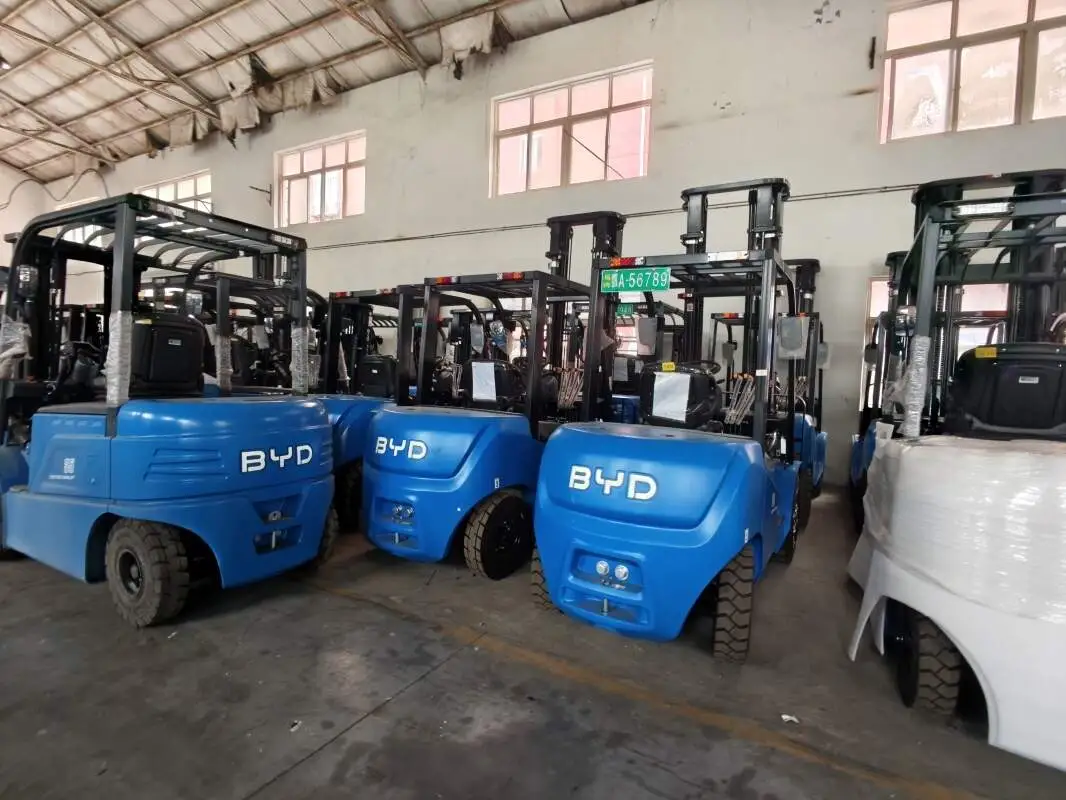
A 3-stage forklift mast is the most widely adopted lifting structure for mainstream electric forklift models, suitable for most common material handling scenarios from warehouse shelf stacking to container cargo access. It is designed to achieve sufficient maximum lifting height, while keeping the overall retracted height at a low level that does not exceed the limit of conventional low overhead passages.
The whole structure consists of three sets of nested high-strength mast profiles, matched with independent hydraulic power units, linkage transmission chains and load-bearing fork mounting brackets. The outermost mast is fixed on the forklift body frame to provide basic support, the middle mast moves up and down along the sliding rails of the outer mast, and the innermost mast is connected with the fork carriage to carry the cargo weight directly.
When the operator activates the lifting control handle, the hydraulic system first delivers stable pressure oil to the primary lifting cylinder, pushing the middle mast to rise along the preset slideway. The linkage chain fixed on the top of the middle mast will pull the inner mast to move upward synchronously at twice the speed of the middle mast, to complete the first stage of lifting. After the middle mast reaches the full stroke of the primary cylinder, the secondary hydraulic cylinder works to continue pushing the inner mast to extend to the preset maximum lifting height.
The whole operation process keeps the stress evenly distributed on all mast profiles, effectively reducing the shaking risk of goods at high lifting positions. If you want to know more about the matching performance of 3-stage mast on high-quality electric forklifts, you can contact Xianshu New Energy, which specializes in BYD electric forklifts, via the email 17399989919@163.com for professional consultation.