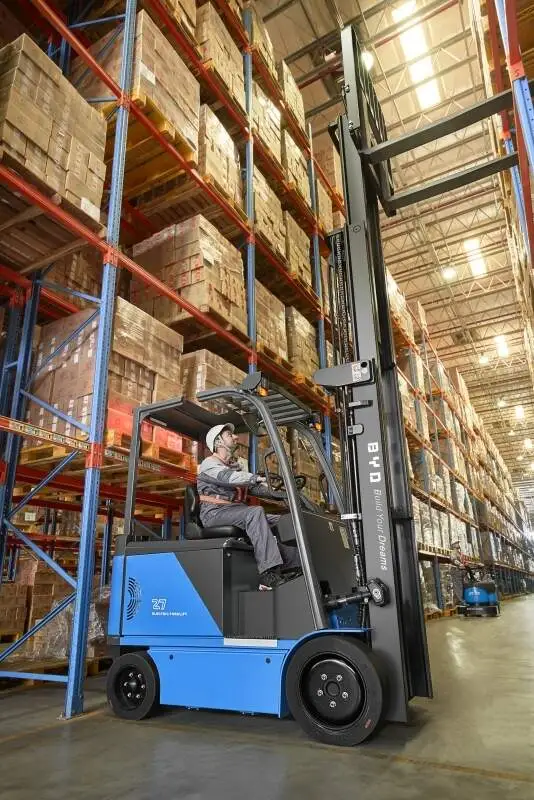
Operating electric forklifts efficiently while maintaining safety is a top priority in warehouses, distribution centers, and industrial settings. One of the most critical safety concerns is forklift overturns, which can lead to severe injuries, property damage, and operational downtime. A key concept to master to prevent such incidents is the forklift tipping point.
The tipping point refers to the threshold where an electric forklift’s center of gravity shifts beyond its base of support, causing it to lose balance and overturn. Every forklift has a defined base of support, formed by the four points where its tires touch the ground. When the center of gravity moves outside this base—whether forward, backward, or sideways—the forklift becomes unstable and is at risk of tipping.
Several factors can alter an electric forklift’s center of gravity and bring it closer to the tipping point. Load weight and placement are primary contributors. Overloading the forklift beyond its rated capacity immediately increases the risk, as does placing loads unevenly or too high on the forks. Uneven or slippery surfaces also play a role; a sloped floor or wet concrete can shift the center of gravity unexpectedly. Additionally, sudden maneuvers like sharp turns, rapid acceleration, or abrupt braking can cause the load to shift, pushing the forklift toward its tipping point.
To reduce overturn risks, operators must learn to recognize signs that the forklift is approaching its tipping point. These include a noticeable tilt of the forklift, the front tires lifting off the ground when carrying a heavy load forward, or the rear tires lifting when reversing with a load. Preventive measures start with proper training: operators should be trained to calculate load capacity correctly, secure loads properly, and adjust their driving style for different surfaces. Regular maintenance is also essential—ensuring tires are properly inflated, brakes are functional, and the forklift’s stability systems are in good working order can prevent unexpected shifts in balance.
During daily operations, operators should avoid driving on slopes steeper than recommended by the forklift’s guidelines. When turning, they should reduce speed and avoid sharp movements that could shift the load. Carrying loads at the lowest possible height helps keep the center of gravity low, enhancing stability. Additionally, operators should never stand or climb on the forklift in a way that alters its center of gravity, and they should always keep their body within the forklift’s cab during operation.
Understanding the forklift tipping point and the factors that influence it is fundamental to creating a safe work environment. By prioritizing proper training, adhering to load capacity guidelines, and practicing cautious driving habits, businesses can significantly reduce the risk of forklift overturns. This not only protects employees and assets but also ensures smooth, uninterrupted operations in industrial and warehouse settings.