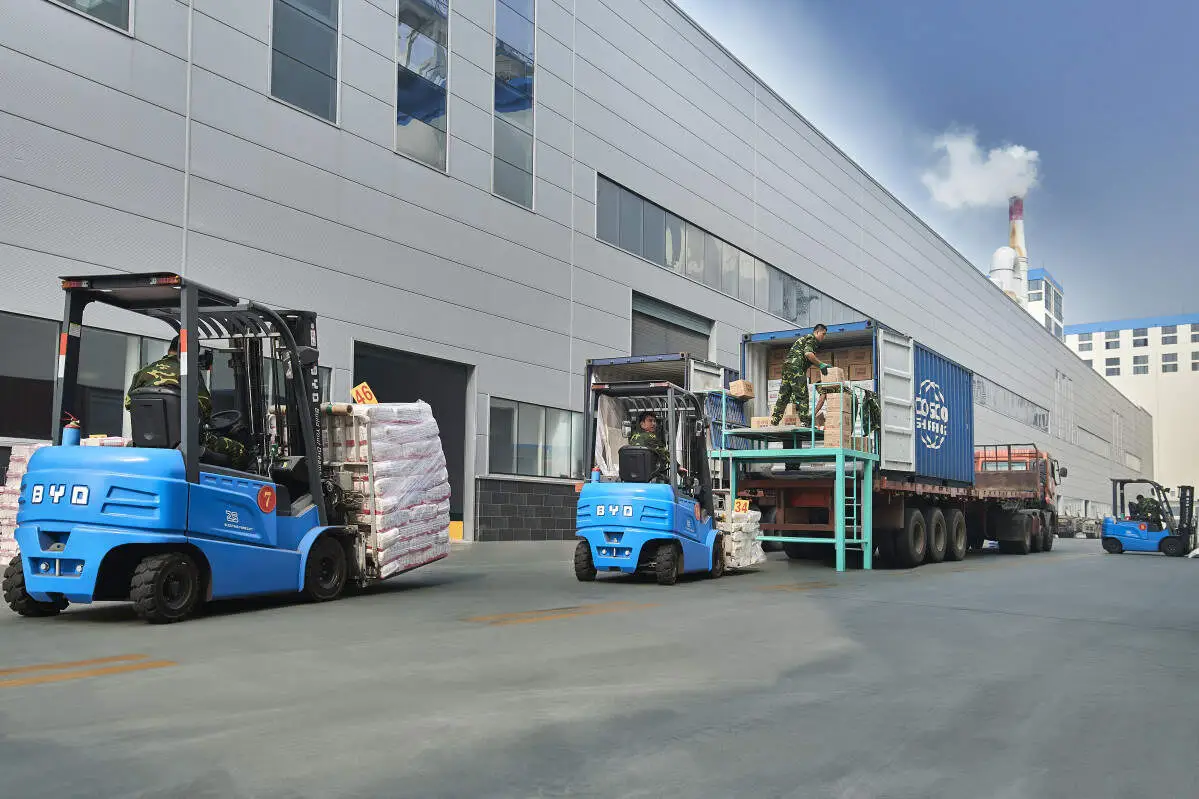
Overload accidents are among the most common and hazardous incidents involving electric forklifts, often leading to tip-overs, equipment damage, and serious injuries. Understanding load center basics is a critical first step in mitigating these risks, as it forms the foundation of safe forklift operation. Jianshu New Energy, a specialist in BYD electric forklifts, emphasizes that mastering these fundamentals is non-negotiable for every operator and fleet manager.
What exactly is a load center? In simple terms, it’s the distance from the face of the forklift’s forks to the center of gravity of the load being lifted. For most standard electric forklifts, the rated load center is typically specified as 24 inches (600 mm) from the fork face. This measurement is crucial because a forklift’s lifting capacity is directly tied to this distance—when the load center shifts farther away from the forks, the forklift’s effective lifting capacity decreases significantly.
Many operators underestimate how a shifted load center impacts stability. For example, if a load is positioned with its center of gravity 30 inches from the fork face instead of the rated 24 inches, the forklift’s safe lifting capacity drops by approximately 20%. This means a forklift rated for 5,000 lbs at a 24-inch load center can only safely lift 4,000 lbs at a 30-inch load center. Ignoring this shift can quickly lead to overload, causing the forklift to tip forward or lose control.
Overload accidents don’t just damage equipment; they pose severe threats to personnel. Tip-overs can crush operators or nearby workers, while sudden load shifts can cause heavy materials to fall, resulting in fractures, lacerations, or worse. Additionally, repeated overload can strain the forklift’s hydraulic system, mast, and tires, leading to premature wear and costly repairs.
To prevent overload accidents related to load center issues, operators should follow several key practices. First, always consult the forklift’s manual to confirm the rated load center and capacity. Before lifting, inspect the load to determine its center of gravity—for irregularly shaped loads, use strapping or pallets to balance the weight and keep the center as close to the fork face as possible. When lifting, ensure the forks are fully inserted under the load, and avoid lifting loads that exceed the adjusted capacity for the actual load center. Regular training sessions for operators, covering load center calculations and safety protocols, are also essential to reinforce good habits.
Jianshu New Energy, which specializes in BYD electric forklifts, offers comprehensive support to help fleets maintain safe operation. Our team of experts can provide guidance on load center management, operator training, and routine maintenance to reduce the risk of overload accidents. For more information, feel free to contact us at 17399989919@163.com.