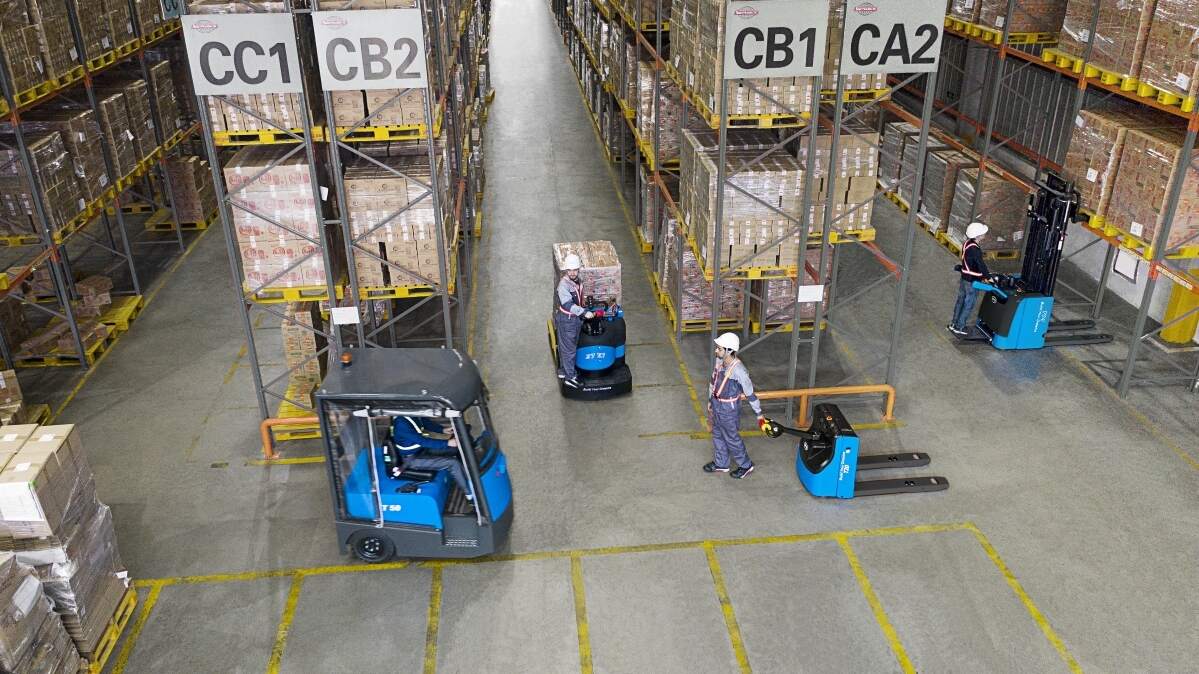
Counterbalance forklifts are essential workhorses across industrial operations, with Class 1, 4, and 5 models engineered to meet distinct material handling needs. Understanding their core specifications is critical for selecting the right equipment to optimize efficiency, safety, and productivity in warehouses, manufacturing facilities, outdoor construction sites, and port yards.
Class 1 counterbalance forklifts are electric-powered, relying on rechargeable battery packs as their energy source. Core specifications include load capacities typically ranging from 1,500 to 18,000 pounds, with lift heights varying between 8 and 30 feet depending on the model. These units feature tight turning radii, often between 6 and 12 feet, making them ideal for navigating narrow warehouse aisles with precision. Electric motors deliver power outputs from 5 to 25 kilowatts, supporting smooth acceleration and consistent lifting performance. Battery charging times range from 8 to 12 hours for a full charge, with some models offering opportunity charging options to extend operational hours. Additionally, Class 1 forklifts produce zero tailpipe emissions and operate at noise levels below 70 decibels, making them perfect for indoor applications where air quality and noise reduction are priorities.
Class 4 counterbalance forklifts are internal combustion (IC) models powered by propane gas. Their specifications cater to semi-outdoor and indoor environments with adequate ventilation, featuring load capacities from 3,000 to 36,000 pounds and lift heights spanning 10 to 35 feet. Turning radii for Class 4 units are slightly larger than Class 1, ranging from 8 to 15 feet, designed to handle wider aisles and heavier loads. Propane engines deliver power ranging from 20 to 75 horsepower, providing robust performance for heavy-duty lifting tasks. Fuel tank capacities vary from 30 to 100 gallons, ensuring extended operational time between refuels. These forklifts are built with durable frames and solid or pneumatic tires suitable for uneven surfaces, and they can operate reliably in temperatures ranging from -20 to 100 degrees Fahrenheit.
Class 5 counterbalance forklifts are diesel-powered IC models, engineered for heavy-duty outdoor applications. Their specifications include load capacities starting at 5,000 pounds and climbing to 60,000 pounds or more for specialized heavy-lift models. Lift heights can reach up to 40 feet, accommodating high-storage racking systems and tall stacking tasks. Turning radii range from 10 to 20 feet, requiring spacious operational areas to maneuver safely. Diesel engines produce 30 to 120 horsepower, delivering the high torque needed to handle heavy loads and traverse rough terrain like construction sites and lumber yards. Fuel tank capacities are larger than Class 4 models, often between 50 and 150 gallons, enabling long periods of continuous use without refueling. Class 5 forklifts are equipped with heavy-duty tires and reinforced components to withstand harsh outdoor conditions.
When evaluating these forklift classes, it’s important to consider not just load capacity and lift height, but also operational environment, energy or fuel source, maintenance requirements, and maneuverability constraints. Each class offers unique advantages tailored to specific tasks, ensuring businesses can select the right equipment to support their material handling goals while adhering to safety standards and operational efficiency targets.