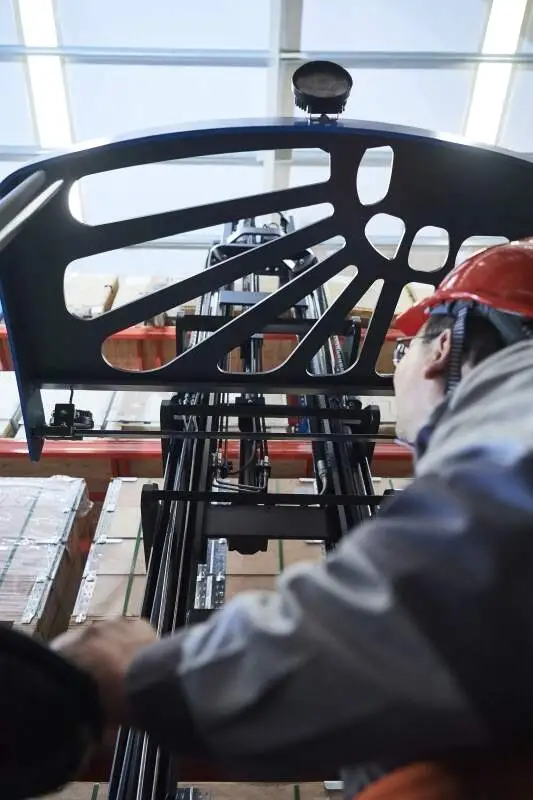
Forks are critical components of industrial forklifts, serving as the primary interface for lifting and transporting heavy loads. For 5 ton industrial forklifts, adhering to standard fork dimension parameters is essential to ensure operational safety, load stability, and compatibility with common pallet sizes in industrial environments. These parameters are established based on industry-wide safety and performance standards, taking into account the forklift’s maximum load capacity and typical material handling scenarios.
The length of forks for 5 ton industrial forklifts typically falls within a standard range, commonly between 1200mm and 1800mm. This length is determined by the need to balance load stability and maneuverability. Longer forks provide better support for larger pallets or longer loads, reducing the risk of load tipping during transport. However, excessively long forks can compromise the forklift’s turning radius and increase the risk of collisions in narrow spaces. Industrial operators must select fork lengths that align with their specific load types and workspace constraints, ensuring compliance with safety guidelines.
Fork thickness and width are key parameters related to load-bearing capacity. For 5 ton forklifts, standard fork thickness usually ranges from 40mm to 50mm, while the width of the fork blade typically measures between 100mm and 120mm. These dimensions are engineered to withstand the compressive and bending forces exerted by 5-ton loads without deformation. Thicker forks offer greater structural integrity, making them suitable for handling dense or heavy-duty materials, while the blade width ensures sufficient contact area with pallets to distribute the load evenly, preventing damage to both the forks and the load.
Fork spacing, or the distance between the inner edges of the two forks, is another critical parameter. The standard adjustable range for 5 ton industrial forklifts is generally between 500mm and 1200mm. This adjustability allows operators to accommodate different pallet sizes, from standard 1200mm x 1000mm pallets to narrower or wider custom pallets. Proper fork spacing ensures that the load is centered on the forks, minimizing the risk of load shifting and maintaining the forklift’s stability during lifting and movement. Operators should always adjust fork spacing to match the pallet dimensions before lifting a load to avoid unsafe conditions.
The height of the fork blade, from the tip to the heel, also follows standard specifications. For 5 ton forklifts, the blade height typically ranges from 150mm to 200mm. This height ensures that the forks can securely slide under pallets without damaging the pallet’s bottom boards. Additionally, the fork’s heel section is designed to fit into the forklift’s carriage mechanism, ensuring a tight and stable connection that can handle the dynamic forces of lifting and lowering heavy loads.
Adhering to these standard fork dimension parameters is not only a matter of operational efficiency but also a critical safety requirement. Non-standard or damaged forks can lead to load failures, equipment damage, and workplace accidents. Regular inspection and maintenance of forks, including checking for wear, deformation, or cracks, are essential to ensure they meet the required standards. By understanding and following these standard dimensions, industrial operators can maximize the performance and safety of their 5 ton forklifts, supporting smooth and reliable material handling operations across various industrial settings.