


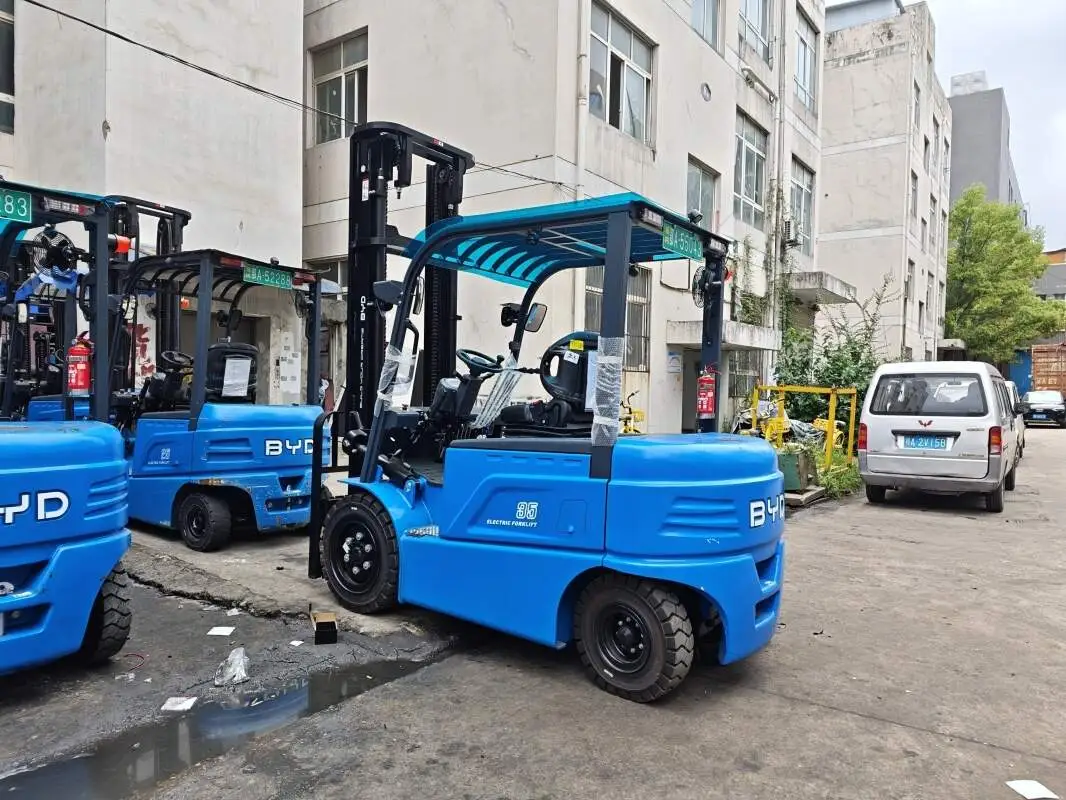
In the daily operation and maintenance of electric forklifts, the accurate selection of vulnerable parts is directly related to the operating stability and service life of the equipment. Among them, handles, filter elements, and seals are the key components for high-frequency replacement, which need to be matched according to the characteristics of the model.
For the selection of the handle, it is necessary to clarify the type of operation and functional requirements of the forklift. For example, for forklifts that focus on storage and stacking, the handle needs to be adapted to multi-gear speed regulation and precise control requirements. It is necessary to pay attention to whether the interface specifications of the handle match the control circuit of the model, and pay attention to whether the button layout of the handle fits the operating logic of the model. For forklifts used for heavy-duty handling, the handle needs to have stronger wear resistance to ensure durability under high-frequency operation. When selecting the model, refer to the operating torque parameters of the model to avoid operation cards due to mismatch of handle torque.
The adaptation of the filter element needs to be combined with the working environment and system parameters of the model. In terms of hydraulic filter elements, the hydraulic system of heavy-duty forklifts has a larger flow rate, so the filter element corresponding to the flow specification needs to be selected, and the filtration accuracy should be adjusted according to the dust concentration of the operation scene. High-precision filter elements need to be selected in dusty environments; air filter elements need to match the size of the intake system of the model. Conventional precision filter elements can be selected for forklifts operating indoors, and filters with high-efficiency dust-proof structures should be selected for outdoor dusty environments to avoid impurities entering the power system and affecting operation.
The matching core of seals lies in material and size adaptation. There are differences in the size of oil cylinders and hydraulic pipelines of different models. When selecting models, it is necessary to accurately measure the inner diameter, outer diameter and thickness parameters of seals to ensure that they fit perfectly with the parts of the model. In addition, forklifts operating outdoors need to choose seal materials that are resistant to aging, low temperature or high temperature, while forklifts operating indoors can choose conventional wear-resistant materials. At the same time, attention should be paid to whether the installation groove of the seals matches the parts of the model to avoid leakage due to improper installation.
Overall, the selection of vulnerable parts for electric forklifts needs to be based on the operating scenarios and system parameters of the vehicle. By accurately matching the specifications and performance of handles, filter elements, and seals, the operation status of the forklift can be effectively guaranteed and the operation and maintenance costs can be reduced.

