Counterbalance forklifts are among the most widely used material handling equipment across industrial warehouses, manufacturing facilities, and logistics centers. Their popularity stems from a well-engineered design that combines structural integrity with reliable load-bearing capabilities. To understand why these forklifts stand out, it’s essential to break down their basic structure and explore the unique advantages that arise from this design.
At the core of a counterbalance forklift is its namesake component: the counterweight. Positioned at the rear of the vehicle, this dense, heavy block is purpose-built to offset the weight of loads lifted by the front forks. The size and weight of the counterweight are calibrated to match the forklift’s rated load capacity, ensuring that the machine maintains a stable center of gravity during operation. Without this critical element, lifting heavy loads would risk tipping the forklift forward, compromising safety and functionality.
The frame serves as the structural backbone of the forklift, integrating all key components into a unified system. It supports the operator’s cabin, power unit, mast assembly, and counterweight, while also providing mounting points for hydraulic lines and control mechanisms. Constructed from high-strength steel, the frame is designed to withstand the stresses of daily operation, including repeated load lifts and maneuvering over uneven surfaces.
The mast and lift system enable the forklift to raise and lower loads with precision. Comprising inner and outer mast rails, hydraulic cylinders, and chain assemblies, this vertical structure allows operators to adjust load height to suit different storage and retrieval needs. The hydraulic system delivers consistent lifting force, ensuring smooth movement even when handling near-maximum capacity loads. Some models include telescopic mast extensions to reach higher storage racks, expanding the forklift’s utility in high-bay warehouses.
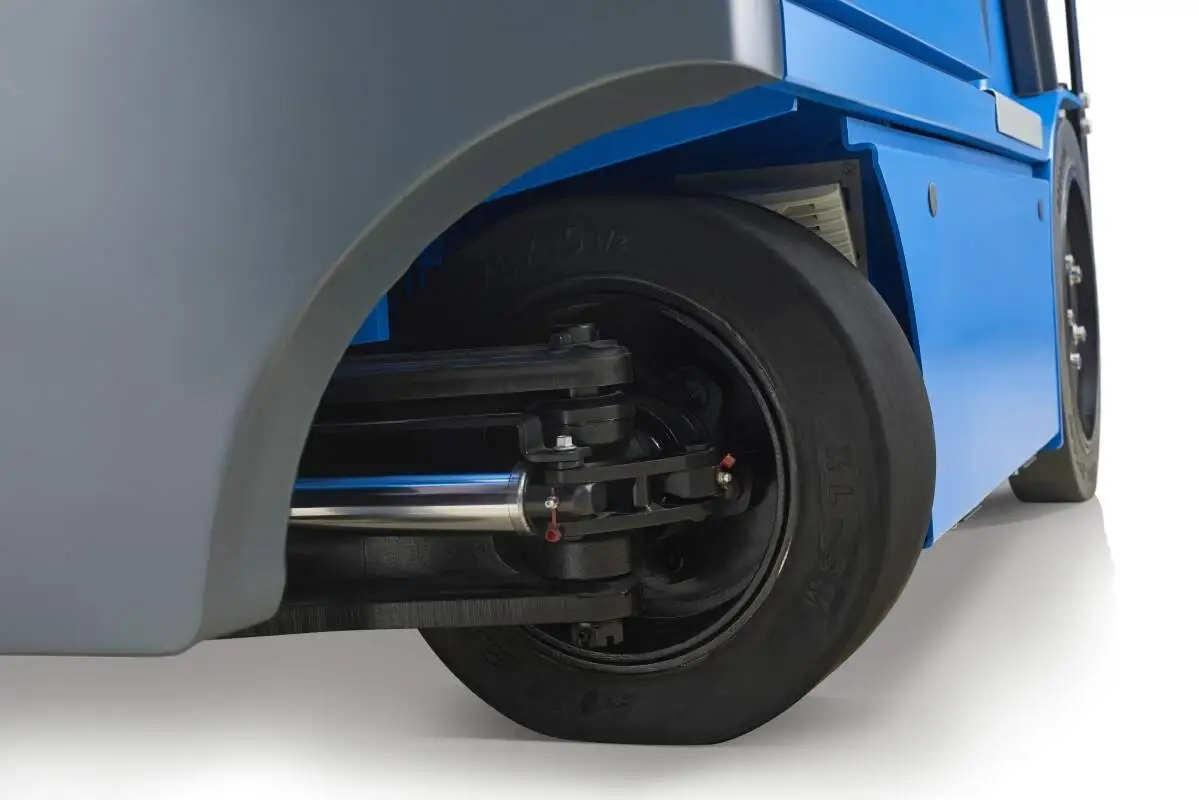
Completing the core structure are the steering and power systems. Most counterbalance forklifts feature rear-wheel steering, which enhances maneuverability in tight spaces—a key advantage in crowded warehouses. Power steering systems reduce operator fatigue, allowing for easy navigation even during long shifts. The power source varies by model: electric forklifts run on rechargeable batteries, making them ideal for indoor use with low emissions, while internal combustion models (powered by gas, diesel, or LPG) offer higher torque for outdoor applications and heavy-duty tasks.
The structural design of counterbalance forklifts translates to several unique load-bearing advantages. First, the integrated counterweight eliminates the need for additional balancing attachments, simplifying operation and reducing setup time compared to other forklift types. This design also ensures exceptional stability: even when lifting heavy loads to full height, the counterweight keeps the center of gravity within safe limits, minimizing the risk of tip-overs.
Another key advantage is versatile load capacity. Counterbalance forklifts are available in a range of sizes, from compact units handling 1-ton loads to heavy-duty models capable of lifting over 50 tons. This adaptability makes them suitable for everything from light warehouse tasks to heavy industrial lifting operations. Additionally, their maneuverability remains uncompromised when carrying loads, allowing operators to navigate narrow aisles and tight turns without sacrificing load stability.
Finally, these forklifts perform reliably across diverse environments. Electric models operate quietly with zero tailpipe emissions, making them perfect for indoor warehouses where air quality and noise levels are concerns. Internal combustion models, on the other hand, thrive in outdoor settings, handling rough terrain and heavy loads with ease. In both cases, the counterbalance design ensures consistent load-bearing performance, supporting efficient material handling operations regardless of the workspace.
In summary, the basic structure of a counterbalance forklift is a masterclass in functional design. Each component works in harmony to deliver stable, versatile, and efficient load-bearing capabilities. Whether used for daily warehouse tasks or heavy industrial lifting, these forklifts remain a top choice for businesses seeking reliable material handling solutions. Proper maintenance, including regular inspections of the counterweight, frame, and hydraulic systems, will help sustain their performance and safety over time.