


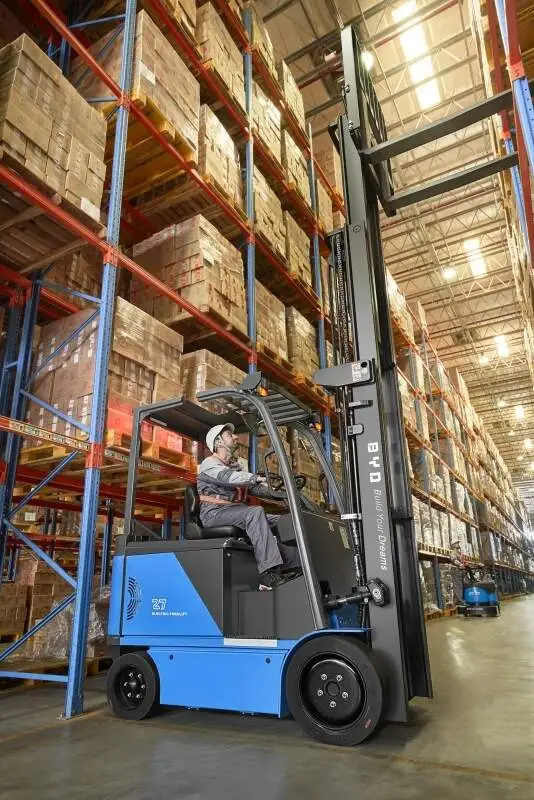
With the refined development of the warehousing and logistics industry, different types of warehousing scenarios have increasingly stringent requirements for the adaptability of operating equipment. From the fast picking of goods in e-commerce warehouses to the batch storage of traditional warehouses, from the flexible operation of narrow passages to the storage of goods on high shelves, the selection of forklifts as core handling equipment directly affects the efficiency of warehousing operations. When faced with pallet trucks and stackers, many warehouse managers often find it difficult to choose due to the differences in scenarios. This article will analyze their application scenarios one by one by combining the characteristics of the two types of forklifts.
Scenarios dominated by plane handling: the core adaptation field of pallet trucks
The core features of the pallet truck are flexibility, lightweight and simple operation, and it is more suitable for warehousing scenarios that are mainly carried over short distances. For example, in the picking process of e-commerce warehousing, when the selected goods need to be transferred from the picking area to the packing area, or when the bulk pallet goods need to be transferred from the warehousing temporary storage area to the sorting station, the small turning radius of the pallet truck can easily shuttle through narrow passages to meet the needs of high-frequency and short-distance handling. In addition, in the loading and unloading platform area, with the loading and unloading operations of containers or trucks, the pallet truck can quickly complete the horizontal transfer of pallet goods, without the need for additional vertical lifting operations, to improve the flow speed of loading and unloading goods. This type of scenario usually has a relatively light load, and the operation route is dominated by horizontal straight lines or small-scale turns. The convenience of operation of the pallet truck maximizes its advantages.
High-level stacking demand scenario: the advantages of stacking trucks
The stacker has a vertical lifting function, which is more suitable for warehousing scenarios with high-level stacking requirements. In three-dimensional warehouses or medium-sized warehouses equipped with multi-layer shelves, when goods need to be stacked to high-level shelves of 3-5 meters, the stacker can safely complete the storage and storage of goods with a stable lifting structure, effectively utilize the vertical space of the warehouse, and improve the storage capacity. In addition, in the palletizing operation scenario of bulk goods, when it is necessary to stack pallet goods layer by layer to the specified height, the precise lifting control of the stacker can ensure that the goods are stacked neatly and avoid tilting or falling goods. For warehousing scenarios with long-term storage requirements, the stacker can cooperate with the high-level shelves to achieve classified storage of goods, which is convenient for later inventory and access operations.
Core Considerations for Selection of Storage Forklifts
In the actual selection, in addition to referring to the type of operation scene, it is also necessary to combine factors such as the space layout of the warehouse, the load weight of the goods, and the frequency of operation. If the warehouse channel is narrow and horizontal handling is the main one, the pallet truck is preferred; if the vertical space needs to be used to complete the high-level stacking operation, the stacking truck is more suitable. Some warehousing scenarios can also be combined with two types of forklifts according to the operation process to achieve a seamless connection between flat handling and high-level stacking, further improving the overall operating efficiency.

