


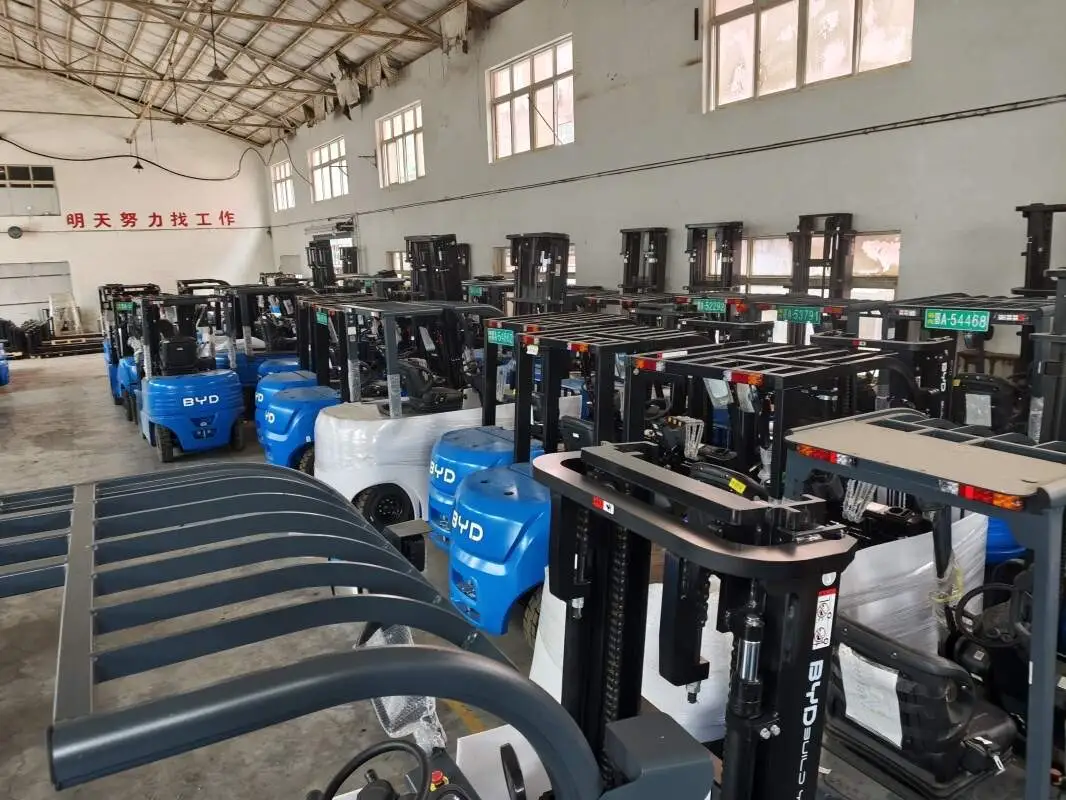
The daily material transfer in light industrial plants involves a variety of types such as small and scattered goods and medium-sized box goods. The operation site is often characterized by narrow passages, frequent crossings of people and vehicles, etc., which puts forward higher requirements for the flexibility, environmental protection and adaptability of handling equipment. BYD QX/GX series electric forklifts have formed a set of adaptation solutions that meet actual needs for this kind of scene characteristics.
The core fundamental advantages of adapting to light industrial scenarios
The QX/GX series electric forklift adopts a compact body design with a small steering radius, which can flexibly turn and turn in the narrow channel of the factory area, and adapt to the short-distance transfer needs between multiple stations. At the same time, the electric drive mode operates with low noise and zero exhaust emissions, which meets the environmental protection requirements of the working environment in light industrial plants and avoids affecting the health of the production workshop and personnel.
Targeted adaptation of different transport scenarios
For the high-frequency transshipment of small and scattered materials, the QX series forklift can quickly shuttle between production stations and temporary storage areas with flexible handling, and with suitable attachments, it can achieve efficient pickup and delivery of goods, and improve the accuracy of single-trip transshipment. For the transshipment needs of medium-sized boxes of goods or bulk materials, the GX series forklift has a moderate load-bearing capacity, which can stably complete the handling of larger weight goods, adapt to the medium and long-distance transshipment tasks from the warehouse to the production workshop, and balance the handling efficiency and equipment load.
Personalized configuration optimization for adaptation requirements
According to the specific characteristics of the materials in the factory, the forklift can be specifically configured and adjusted. For example, when handling fragile goods, flexible forks or protective devices can be selected; for long-distance transfer scenarios, large-capacity batteries can be matched to extend the battery life of a single operation; for scenarios that require frequent loading and unloading of cargo platforms, the lift height of the fork can be adjusted to adapt to different cargo platform sizes.
Long-term adaptation of operation and maintenance and performance assurance
In order to ensure that the forklift continues to adapt to the needs of the factory, a regular operation and maintenance mechanism needs to be established, including daily battery inspections, lubrication of body parts, calibration of the control system, etc. At the same time, targeted training is provided for operators to familiarize them with the operation skills of forklifts in different scenarios, further improving the safety and efficiency of material transfer, so that the adaptability of QX/GX forklifts can be exerted for a long time.

