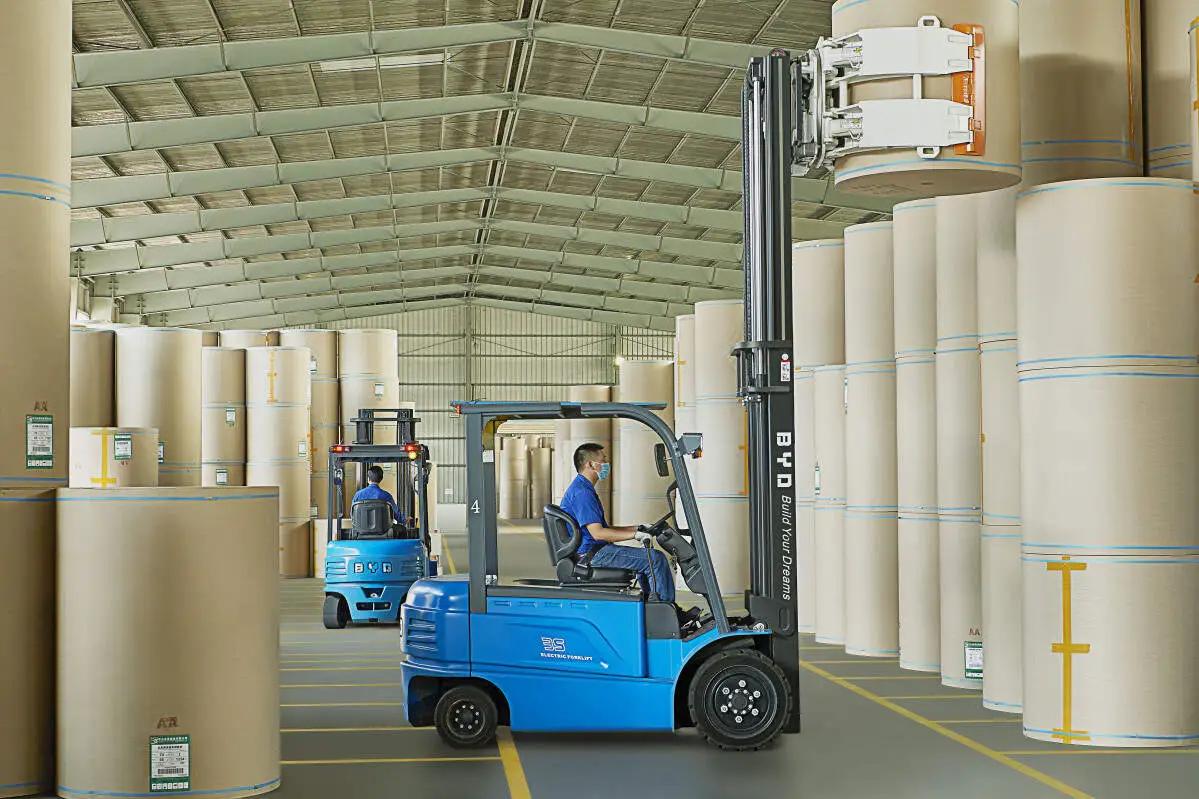
Ausführliche Erläuterung der Portalkonfiguration mit unterschiedlichen Hubhöhen für 5-Tonnen-Lithiumbatterie-Gabelstapler

2026-06-24

Ausführliche Erläuterung der Portalkonfiguration mit unterschiedlichen Hubhöhen für 5-Tonnen-Lithiumbatterie-Gabelstapler(Figur1)

Im Bereich der Elektrostapler werden 5-Tonnen-Lithium-Ionen-Gabelstapler aufgrund ihrer stabilen Tragfähigkeit und ihres sauberen und effizienten Energiesystems häufig in der Lagerhaltung, in der Logistik, in Produktionsanlagen und in anderen Bereichen eingesetzt. Als Kernkomponente, die sich auf die Be- und Entladeeffizienz und den Einsatzbereich auswirkt, muss das Portal entsprechend den tatsächlichen Betriebsanforderungen ausgewählt werden. Im Folgenden werden wir die gängigen Konfigurationstypen und Auswahlpunkte im Detail erläutern.

Beginnen wir mit dem Standard-Türrahmen mit einer herkömmlichen Hubhöhe. Die Hubhöhe des Standard-Türrahmens liegt in der Regel zwischen 3 Metern und 4,5 Metern, und die Struktur ist relativ einfach. Er besteht aus Komponenten wie dem äußeren Türrahmen, dem inneren Türrahmen und dem Hubzylinder. Es gibt keine vollständige freie Hebefunktion. Während des Betriebs wird die Gabel vor dem Anheben des inneren Türrahmens über eine Strecke vom gesamten Türrahmen angehoben. Dieser Abstand wird als freie Hubhöhe bezeichnet, die im Allgemeinen 500 mm bis 800 mm beträgt. Die Vorteile des Standard-Türrahmens sind die niedrigen Herstellungskosten, die bequeme Wartung und der geringe Lastverlust. Es eignet sich für Szenen, in denen der Arbeitsraum offen ist und die Höhe des Türrahmens nicht streng begrenzt ist, wie z. B. die Handhabung großer Paletten auf Freiluftfrachthöfen und die Sortierung von Waren der unteren und mittleren Ebene in Lagern mit ausreichender Bodenhöhe in der Werkstatt.

Werfen wir einen Blick auf den einstufigen vollfreien Türrahmen mit mittlerer und hoher Hubhöhe. Der einstufige vollfreie Türrahmen fügt einen vollfreien Hubzylinder auf der Grundlage des Standardtürrahmens hinzu, der die Funktion des vollständigen Anhebens der Gabel bis zur Oberseite des inneren Türrahmens realisieren kann, und dann wird der innere Türrahmen synchron mit dem äußeren Türrahmen angehoben. Die freie Hubhöhe kann etwa 3 Meter erreichen, und die Gesamthubhöhe liegt normalerweise zwischen 4,5 Metern und 6 Metern. Diese Konfiguration der Türrahmen eignet sich für Szenarien mit bestimmten Höhenbeschränkungen, wie z. B. die Regale im zweiten Stock gewöhnlicher Lagerhäuser und das Be- und Entladen von Waren mittlerer und hoher Höhe in Containern. Die Gabel kann in eine höhere Position angehoben werden, ohne den Türrahmen anzuheben, um Kollisionen mit oberen Hindernissen zu vermeiden. Allerdings ist der Lastverlust eines einstufigen, völlig freien Portals etwas größer als der eines Standardportals, und auch die Herstellungskosten steigen entsprechend.

Schließlich gibt es noch das zweistufige vollfreie Portal mit hoher Hubhöhe. Die Struktur des zweistufigen vollfreien Portals ist komplizierter und umfasst ein zweistufiges Innenportal und einen mehrstufigen vollfreien Hubzylinder. Die freie Hubhöhe kann im Allgemeinen etwa die Hälfte der gesamten Hubhöhe des Portals abdecken, und die gesamte Hubhöhe kann 6 bis 8 Meter oder sogar noch höher erreichen. Diese Konfiguration eignet sich vor allem für Hochhausregale, mehrschichtige Containerstapelung und andere Szenarien, die eine extrem hohe Hubhöhe erfordern, und kann auch mit der Umgebung fertig werden, in der die Höhe des Portals streng begrenzt ist. Es ist zu beachten, dass der Lastverlust des zweistufigen vollfreien Portals größer ist, der Wartungsbedarf ebenfalls höher ist und die Beschaffungskosten relativ hoch sind. Bei der Auswahl des Modells müssen die tatsächliche Betriebsfrequenz und die Bodenhöhenverhältnisse umfassend berücksichtigt werden.

We use cookie to improve your online experience. By continuing to browse this website, you agree to our use of cookie.

Cookies

Please read our Terms and Conditions and this Policy before accessing or using our Services. If you cannot agree with this Policy or the Terms and Conditions, please do not access or use our Services. If you are located in a jurisdiction outside the European Economic Area, by using our Services, you accept the Terms and Conditions and accept our privacy practices described in this Policy.
We may modify this Policy at any time, without prior notice, and changes may apply to any Personal Information we already hold about you, as well as any new Personal Information collected after the Policy is modified. If we make changes, we will notify you by revising the date at the top of this Policy. We will provide you with advanced notice if we make any material changes to how we collect, use or disclose your Personal Information that impact your rights under this Policy. If you are located in a jurisdiction other than the European Economic Area, the United Kingdom or Switzerland (collectively “European Countries”), your continued access or use of our Services after receiving the notice of changes, constitutes your acknowledgement that you accept the updated Policy. In addition, we may provide you with real time disclosures or additional information about the Personal Information handling practices of specific parts of our Services. Such notices may supplement this Policy or provide you with additional choices about how we process your Personal Information.


Cookies

Cookies are small text files stored on your device when you access most Websites on the internet or open certain emails. Among other things, Cookies allow a Website to recognize your device and remember if you've been to the Website before. Examples of information collected by Cookies include your browser type and the address of the Website from which you arrived at our Website as well as IP address and clickstream behavior (that is the pages you view and the links you click).We use the term cookie to refer to Cookies and technologies that perform a similar function to Cookies (e.g., tags, pixels, web beacons, etc.). Cookies can be read by the originating Website on each subsequent visit and by any other Website that recognizes the cookie. The Website uses Cookies in order to make the Website easier to use, to support a better user experience, including the provision of information and functionality to you, as well as to provide us with information about how the Website is used so that we can make sure it is as up to date, relevant, and error free as we can. Cookies on the Website We use Cookies to personalize your experience when you visit the Site, uniquely identify your computer for security purposes, and enable us and our third-party service providers to serve ads on our behalf across the internet.

We classify Cookies in the following categories:
 ●  Strictly Necessary Cookies
 ●  Performance Cookies
 ●  Functional Cookies
 ●  Targeting Cookies


Cookie List
A cookie is a small piece of data (text file) that a website – when visited by a user – asks your browser to store on your device in order to remember information about you, such as your language preference or login information. Those cookies are set by us and called first-party cookies. We also use third-party cookies – which are cookies from a domain different than the domain of the website you are visiting – for our advertising and marketing efforts. More specifically, we use cookies and other tracking technologies for the following purposes:

Strictly Necessary Cookies
These cookies are necessary for the website to function and cannot be switched off in our systems. They are usually only set in response to actions made by you which amount to a request for services, such as setting your privacy preferences, logging in or filling in forms. You can set your browser to block or alert you about these cookies, but some parts of the site will not then work. These cookies do not store any personally identifiable information.

Functional Cookies
These cookies enable the website to provide enhanced functionality and personalisation. They may be set by us or by third party providers whose services we have added to our pages. If you do not allow these cookies then some or all of these services may not function properly.

Performance Cookies
These cookies allow us to count visits and traffic sources so we can measure and improve the performance of our site. They help us to know which pages are the most and least popular and see how visitors move around the site. All information these cookies collect is aggregated and therefore anonymous. If you do not allow these cookies we will not know when you have visited our site, and will not be able to monitor its performance.

Targeting Cookies
These cookies may be set through our site by our advertising partners. They may be used by those companies to build a profile of your interests and show you relevant adverts on other sites. They do not store directly personal information, but are based on uniquely identifying your browser and internet device. If you do not allow these cookies, you will experience less targeted advertising.

How To Turn Off Cookies
You can choose to restrict or block Cookies through your browser settings at any time. Please note that certain Cookies may be set as soon as you visit the Website, but you can remove them using your browser settings. However, please be aware that restricting or blocking Cookies set on the Website may impact the functionality or performance of the Website or prevent you from using certain services provided through the Website. It will also affect our ability to update the Website to cater for user preferences and improve performance. Cookies within Mobile Applications

We only use Strictly Necessary Cookies on our mobile applications. These Cookies are critical to the functionality of our applications, so if you block or delete these Cookies you may not be able to use the application. These Cookies are not shared with any other application on your mobile device. We never use the Cookies from the mobile application to store personal information about you.

If you have questions or concerns regarding any information in this Privacy Policy, please contact us by email at . You can also contact us via our customer service at our Site.