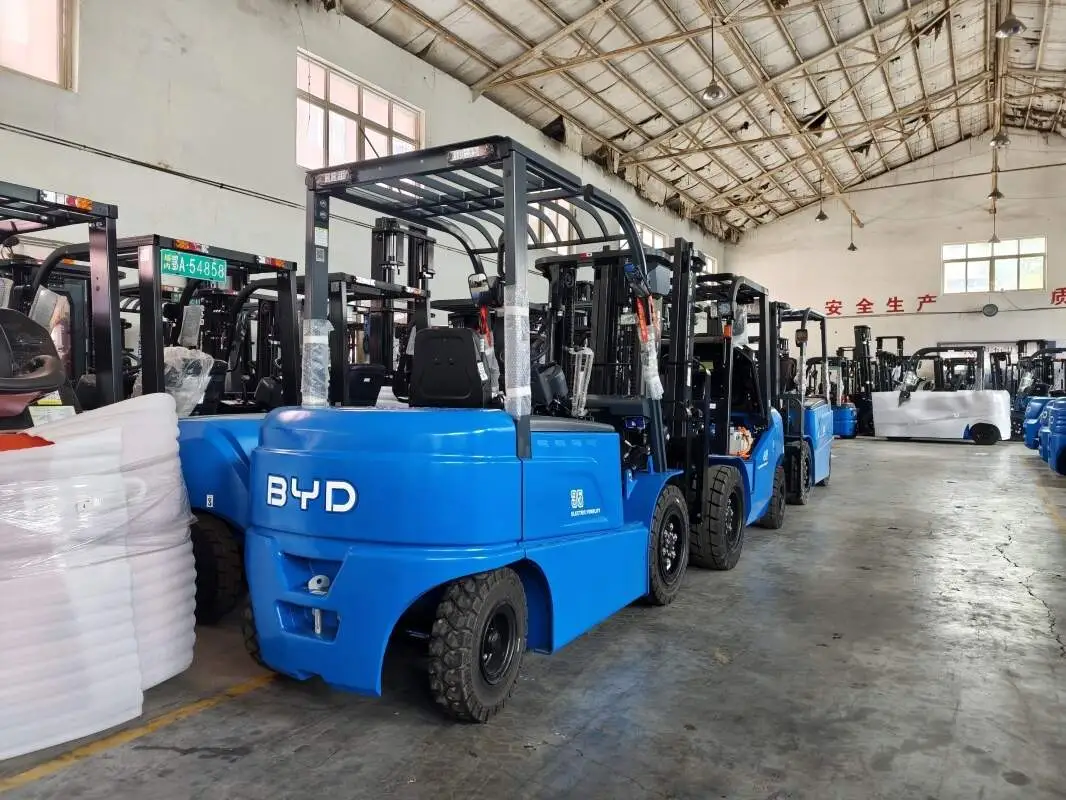
Neue Energie Gabelstapler Markt Gleichgewicht schwere Lithium-Batterie Gabelstapler Entwicklungstrend

2026-06-26

Neue Energie Gabelstapler Markt Gleichgewicht schwere Lithium-Batterie Gabelstapler Entwicklungstrend(Figur1)

Mit der steigenden Nachfrage nach umweltfreundlichen und effizienten Geräten im Bereich der Industrielogistik wächst der Markt für neue Energiegabelstapler weiter. Mit seinen einzigartigen Leistungsvorteilen ist der ausgewogene Lithium-Ionen-Gabelstapler allmählich zur Kernkategorie des Marktes geworden, und sein Entwicklungstrend zeigt auch einen Trend zu mehreren Upgrades.

Technologie-Iteration: doppelte Verbesserung von Leistung und Intelligenz

Die Batterietechnologie wird weiter optimiert

Gegenwärtig entwickelt sich die Batterietechnologie des schweren Lithium-Batterie-Gabelstaplers in Richtung hoher Energiedichte und langer Zykluslebensdauer. Durch die Verbesserung der Batteriezellenmaterialien wird die Energiedichte der Batterie schrittweise erhöht, was eine größere Reichweite für den Gabelstapler bei gleichem Volumen bietet und die Anforderungen eines langfristigen Dauerbetriebs erfüllt. Gleichzeitig wird auch die Anwendung der Schnellladetechnik immer ausgereifter, was die Wartezeit beim Laden erheblich verkürzt und die Effizienz der Ausrüstung verbessert.

Intelligente Funktionen werden kontinuierlich integriert

Um sich dem Entwicklungsrhythmus der intelligenten Logistik anzupassen, werden schwere Lithium-Ionen-Gabelstapler nach und nach mit verschiedenen intelligenten Funktionen ausgestattet. Beispielsweise können Gabelstapler, die mit automatischen Navigationssystemen ausgestattet sind, eine autonome Bahnplanung erreichen und manuelle Bedienungsfehler reduzieren; Echtzeit-Statusüberwachungsfunktionen können Daten wie Batteriestrom und Betriebsausfälle sammeln und analysieren, Frühwarnungen vor potenziellen Problemen geben und die Betriebs- und Wartungskosten der Ausrüstung reduzieren.

Anwendungsszenarien: Erweiterung von Innenräumen auf verschiedene Szenarien

Vertiefung der Anwendung traditioneller Lagerungsszenarien

Im Bereich der Lagerhaltung und Logistik hat sich der schwere Lithium-Gabelstapler aufgrund seiner Vorteile - keine Emissionen und geringe Geräuschentwicklung - zur Hauptausrüstung für den Innenbetrieb entwickelt. Seine flexible Lenkleistung und stabile Tragfähigkeit können sich an komplexe Lagerumgebungen wie enge Gassen und hohe Regale anpassen und die Effizienz des Frachtumschlags verbessern.

Durchbruch bei Hochleistungseinsätzen im Freien

Mit der Verbesserung der Batterieleistung haben Lithium-Ionen-Gegengewichtsstapler begonnen, sich auf schwere Betriebsszenarien im Freien auszuweiten. In Häfen, Bergwerken, großen Produktionsstätten und anderen Szenarien können Lithium-Ionen-Gabelstapler herkömmliche Kraftstoffstapler ersetzen, um schwere Frachtumschlagaufgaben zu erfüllen, und erfüllen sowohl hohe Lastanforderungen als auch Anforderungen an den Umweltschutz.

Politik und Märkte: Beschleunigung der Einführung durch doppelte Impulse

Grüne politische Leitlinien

Die Förderung inländischer Ziele für den doppelten Kohlenstoffgehalt und die Einführung von Umweltschutzmaßnahmen für mobile Maschinen und Geräte an verschiedenen Orten haben die Unternehmen dazu veranlasst, den Ersatz von Gabelstaplern mit stark verschmutzendem Kraftstoff zu beschleunigen und auf umweltfreundlichere Lithium-Ionen-Gabelstapler mit Gegengewicht umzusteigen. Einschlägige Subventionsmaßnahmen unterstützen Unternehmen auch beim Kauf von Lithium-Ionen-Gabelstaplern, wodurch die Anwendungsschwelle weiter gesenkt wird.

Forderung nach Kostensenkung im Unternehmen

Unter dem Gesichtspunkt der langfristigen Nutzungskosten sind die Energieverbrauchskosten von ausgewogenen schweren Lithium-Gabelstaplern niedriger als die von Kraftstoffstaplern, und der Wartungsprozess ist einfacher, was den Unternehmen eine Menge Betriebskosten sparen kann. Dieser Kostenvorteil hat dazu geführt, dass sich immer mehr Unternehmen für Lithium-Gabelstapler entscheiden, was die Popularität des Marktes gefördert hat.

Zukunftsausblick: Integrierte und zirkuläre Entwicklung

Integriertes Design der Ausrüstung

In Zukunft wird sich der ausgewogene Hochleistungs-Lithium-Ionen-Gabelstapler in Richtung eines integrierten Designs der gesamten Maschine entwickeln, mit einem höheren Grad an Integration zwischen der Batterie und der Karosseriestruktur, was nicht nur die Stabilität der Ausrüstung verbessert, sondern auch die Raumnutzung weiter optimiert und sich an speziellere Betriebsszenarien anpasst.

Das Batterie-Recycling-System ist perfekt

Mit der zunehmenden Zahl von Lithium-Ionen-Gabelstaplern wird das Recycling von Batterien in den Mittelpunkt der Branche rücken. Nach und nach wird ein komplettes System für das Recycling, die Demontage und die Kaskadennutzung von Batterien eingeführt, das nicht nur die Ressourcenverschwendung verringert, sondern auch die Lebenszykluskosten der Geräte weiter senkt und die nachhaltige Entwicklung der Branche fördert.

We use cookie to improve your online experience. By continuing to browse this website, you agree to our use of cookie.

Cookies

Please read our Terms and Conditions and this Policy before accessing or using our Services. If you cannot agree with this Policy or the Terms and Conditions, please do not access or use our Services. If you are located in a jurisdiction outside the European Economic Area, by using our Services, you accept the Terms and Conditions and accept our privacy practices described in this Policy.
We may modify this Policy at any time, without prior notice, and changes may apply to any Personal Information we already hold about you, as well as any new Personal Information collected after the Policy is modified. If we make changes, we will notify you by revising the date at the top of this Policy. We will provide you with advanced notice if we make any material changes to how we collect, use or disclose your Personal Information that impact your rights under this Policy. If you are located in a jurisdiction other than the European Economic Area, the United Kingdom or Switzerland (collectively “European Countries”), your continued access or use of our Services after receiving the notice of changes, constitutes your acknowledgement that you accept the updated Policy. In addition, we may provide you with real time disclosures or additional information about the Personal Information handling practices of specific parts of our Services. Such notices may supplement this Policy or provide you with additional choices about how we process your Personal Information.


Cookies

Cookies are small text files stored on your device when you access most Websites on the internet or open certain emails. Among other things, Cookies allow a Website to recognize your device and remember if you've been to the Website before. Examples of information collected by Cookies include your browser type and the address of the Website from which you arrived at our Website as well as IP address and clickstream behavior (that is the pages you view and the links you click).We use the term cookie to refer to Cookies and technologies that perform a similar function to Cookies (e.g., tags, pixels, web beacons, etc.). Cookies can be read by the originating Website on each subsequent visit and by any other Website that recognizes the cookie. The Website uses Cookies in order to make the Website easier to use, to support a better user experience, including the provision of information and functionality to you, as well as to provide us with information about how the Website is used so that we can make sure it is as up to date, relevant, and error free as we can. Cookies on the Website We use Cookies to personalize your experience when you visit the Site, uniquely identify your computer for security purposes, and enable us and our third-party service providers to serve ads on our behalf across the internet.

We classify Cookies in the following categories:
 ●  Strictly Necessary Cookies
 ●  Performance Cookies
 ●  Functional Cookies
 ●  Targeting Cookies


Cookie List
A cookie is a small piece of data (text file) that a website – when visited by a user – asks your browser to store on your device in order to remember information about you, such as your language preference or login information. Those cookies are set by us and called first-party cookies. We also use third-party cookies – which are cookies from a domain different than the domain of the website you are visiting – for our advertising and marketing efforts. More specifically, we use cookies and other tracking technologies for the following purposes:

Strictly Necessary Cookies
These cookies are necessary for the website to function and cannot be switched off in our systems. They are usually only set in response to actions made by you which amount to a request for services, such as setting your privacy preferences, logging in or filling in forms. You can set your browser to block or alert you about these cookies, but some parts of the site will not then work. These cookies do not store any personally identifiable information.

Functional Cookies
These cookies enable the website to provide enhanced functionality and personalisation. They may be set by us or by third party providers whose services we have added to our pages. If you do not allow these cookies then some or all of these services may not function properly.

Performance Cookies
These cookies allow us to count visits and traffic sources so we can measure and improve the performance of our site. They help us to know which pages are the most and least popular and see how visitors move around the site. All information these cookies collect is aggregated and therefore anonymous. If you do not allow these cookies we will not know when you have visited our site, and will not be able to monitor its performance.

Targeting Cookies
These cookies may be set through our site by our advertising partners. They may be used by those companies to build a profile of your interests and show you relevant adverts on other sites. They do not store directly personal information, but are based on uniquely identifying your browser and internet device. If you do not allow these cookies, you will experience less targeted advertising.

How To Turn Off Cookies
You can choose to restrict or block Cookies through your browser settings at any time. Please note that certain Cookies may be set as soon as you visit the Website, but you can remove them using your browser settings. However, please be aware that restricting or blocking Cookies set on the Website may impact the functionality or performance of the Website or prevent you from using certain services provided through the Website. It will also affect our ability to update the Website to cater for user preferences and improve performance. Cookies within Mobile Applications

We only use Strictly Necessary Cookies on our mobile applications. These Cookies are critical to the functionality of our applications, so if you block or delete these Cookies you may not be able to use the application. These Cookies are not shared with any other application on your mobile device. We never use the Cookies from the mobile application to store personal information about you.

If you have questions or concerns regarding any information in this Privacy Policy, please contact us by email at . You can also contact us via our customer service at our Site.