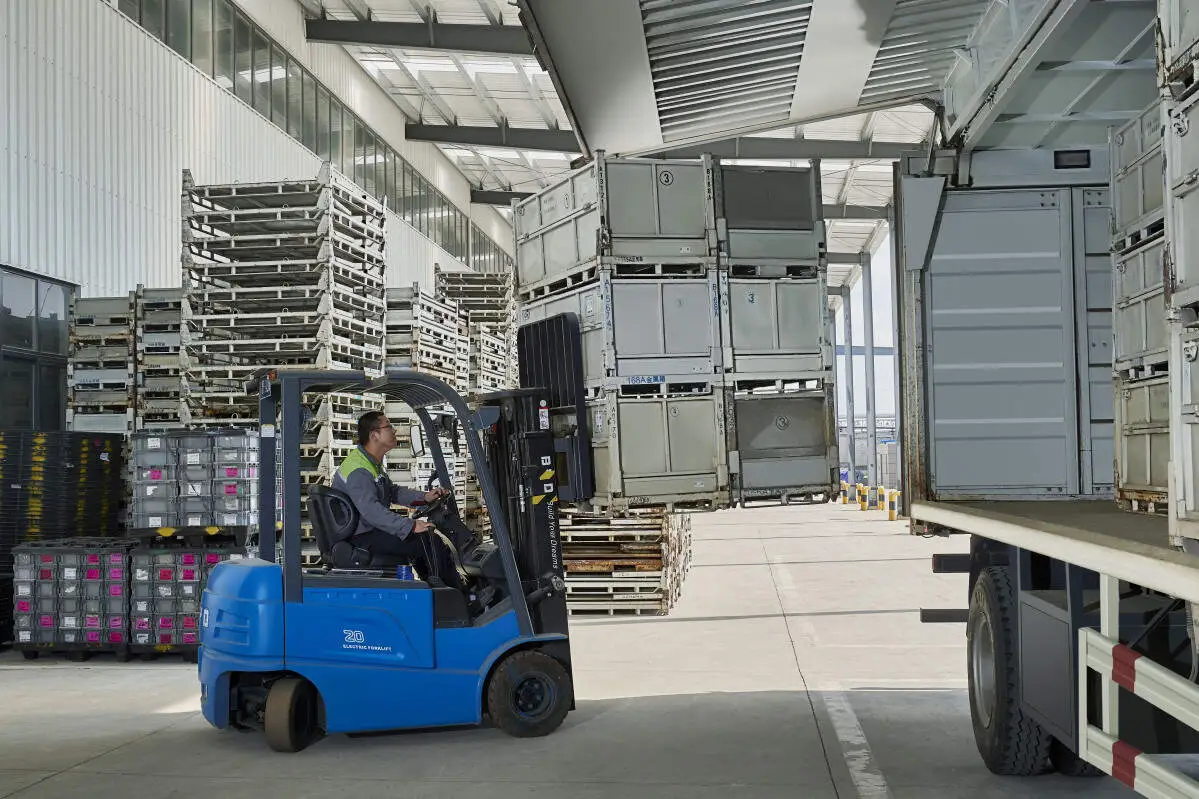
Übersee-Lagerhaltung unterstützt Balance schwere Lithium-Batterie Gabelstapler Auswahl Referenz

2026-06-26

Übersee-Lagerhaltung unterstützt Balance schwere Lithium-Batterie Gabelstapler Auswahl Referenz(Figur1)

Anpassung an Betriebsszenarien in Übersee

Kombiniert mit der Auswahl des Speicherplatzes

Die räumliche Anordnung von Überseelagern ist sehr unterschiedlich, und E-Commerce-Lager mit schmalen Kanälen und Industrielager mit großer Spannweite haben unterschiedliche Anforderungen an Gabelstapler. Bei Lagern mit schmaler Kanalbreite muss auf den minimalen Wenderadius von Gabelstaplern geachtet werden, um eine flexible Lenkung auf begrenztem Raum zu gewährleisten und Arbeitsbehinderungen zu vermeiden; bei Lagern mit großer Spannweite kann man sich auf Modelle mit hoher Tragfähigkeit konzentrieren, um die Effizienz des Schüttgutumschlags zu verbessern.

Passende Art und Häufigkeit der Aufträge

Es gibt Unterschiede in den Leistungsanforderungen von Gabelstaplern für verschiedene Betriebsarten. Herkömmliche Vorgänge wie das Be- und Entladen und Stapeln von Paletten müssen die Aufzugsstabilität und den Bedienkomfort von Gabelstaplern gewährleisten. In Lagerungsszenarien mit hoher Umschlagshäufigkeit sollten Modelle mit langer Batterielebensdauer und Dauerbetrieb bevorzugt werden, um die Auswirkungen der Aufladung auf halbem Weg auf den Betriebsrhythmus zu verringern.

Berücksichtigung der wichtigsten Leistungsparameter

Akkulaufzeit und Ladekapazität

In Überseelagern wird meist ein langfristiger Dauerbetrieb verwendet, bei dem die entsprechende Kapazität der Lithiumbatterien entsprechend der durchschnittlichen täglichen Betriebszeit angepasst werden muss, und es wird auf die Ladeeffizienz geachtet. Die Schnellladefunktion kann die Ausfallzeiten effektiv verkürzen und die Gesamteffizienz des Betriebs verbessern. Darüber hinaus kann es in einigen Überseelagern an professionellen Ladestationen mangeln, so dass es notwendig ist, einen Lademodus zu wählen, der für gewöhnliche Stromversorgungen geeignet ist, um die Kosten für die Standortumwandlung zu senken.

Last- und Hubanzeigen

Bei der Auswahl eines Modells ist es notwendig, den geeigneten Lastbereich und die Hubhöhe auf der Grundlage des Gewichts und der Regalhöhe der häufig verwendeten Waren im Lager zu bestimmen. Handelt es sich bei dem Lager hauptsächlich um schwere Güter, ist es notwendig, ein Modell mit einem höheren Beladungsniveau zu wählen, um zu vermeiden, dass Überlastvorgänge die Lebensdauer der Ausrüstung beeinträchtigen; in Szenarien mit hohen Regalhöhen muss sichergestellt werden, dass die Hubhöhe des Gabelstaplers die oberste Schicht des Regals abdecken kann, um den Stapelbedarf zu decken.

Bewertung von Betrieb und langfristigen Kosten

Batterielebensdauer und einfache Wartung

Die Anzahl der Batteriezyklen eines Lithium-Ionen-Gabelstaplers wirkt sich direkt auf die Lebensdauer des Geräts aus. Bei der Auswahl eines Modells können Sie auf die Zykluslebensdauerparameter der Batterie achten und dem Modell mit besserer Haltbarkeit den Vorrang geben. Darüber hinaus sind die Wartungsressourcen der Überseelager relativ begrenzt. Es ist notwendig, einen Gabelstapler mit einer einfachen Struktur und universellen Verschleißteilen zu wählen, um die Schwierigkeiten bei der täglichen Wartung und die Kosten für die Anschaffung von Zubehör zu verringern.

Lebenszykluskalkulation

Neben den Kosten für die Beschaffung der Ausrüstung müssen auch der langfristige Stromverbrauch, die Wartung, die Kosten für den Austausch von Teilen usw. berechnet werden. Im Vergleich zu herkömmlichen Brennstoffstaplern haben Lithium-Ionen-Gabelstapler mehr Vorteile bei den Energiekosten, aber sie müssen lokale Strompreise und Wartungsressourcen kombinieren, um die gesamten Lebenszykluskosten umfassend zu bewerten und ein kostengünstigeres Modell auszuwählen.

Gleichgewicht zwischen Compliance und Lokalisierung

Erfüllen Sie Sicherheitsstandards in Übersee

Verschiedene Länder und Regionen haben klare Sicherheitsstandards für Industriefahrzeuge. Bei der Auswahl der Modelle muss sichergestellt werden, dass die Gabelstapler die vor Ort geltenden Zertifizierungen bestehen, um den normalen Gebrauch nicht durch Compliance-Probleme zu beeinträchtigen. Gleichzeitig ist es notwendig, auf die Sicherheitskonfiguration der Gabelstapler zu achten, wie z. B. Kollisionswarnung, Bremssystem usw., um die Betriebssicherheit zu verbessern.

Lokalisierte Überlegungen zum Kundendienst

Die Lagerung im Ausland ist weit von China entfernt, und die rechtzeitige Wartung nach einem Geräteausfall ist von entscheidender Bedeutung. Bei der Auswahl eines Modells ist es notwendig, die Abdeckung des lokalen Kundendienstnetzes zu verstehen, um sicherzustellen, dass Wartungsdienste und Ersatzteillieferungen schnell in Anspruch genommen werden können und der durch Ausfallzeiten verursachte Verlust reduziert werden kann.

We use cookie to improve your online experience. By continuing to browse this website, you agree to our use of cookie.

Cookies

Please read our Terms and Conditions and this Policy before accessing or using our Services. If you cannot agree with this Policy or the Terms and Conditions, please do not access or use our Services. If you are located in a jurisdiction outside the European Economic Area, by using our Services, you accept the Terms and Conditions and accept our privacy practices described in this Policy.
We may modify this Policy at any time, without prior notice, and changes may apply to any Personal Information we already hold about you, as well as any new Personal Information collected after the Policy is modified. If we make changes, we will notify you by revising the date at the top of this Policy. We will provide you with advanced notice if we make any material changes to how we collect, use or disclose your Personal Information that impact your rights under this Policy. If you are located in a jurisdiction other than the European Economic Area, the United Kingdom or Switzerland (collectively “European Countries”), your continued access or use of our Services after receiving the notice of changes, constitutes your acknowledgement that you accept the updated Policy. In addition, we may provide you with real time disclosures or additional information about the Personal Information handling practices of specific parts of our Services. Such notices may supplement this Policy or provide you with additional choices about how we process your Personal Information.


Cookies

Cookies are small text files stored on your device when you access most Websites on the internet or open certain emails. Among other things, Cookies allow a Website to recognize your device and remember if you've been to the Website before. Examples of information collected by Cookies include your browser type and the address of the Website from which you arrived at our Website as well as IP address and clickstream behavior (that is the pages you view and the links you click).We use the term cookie to refer to Cookies and technologies that perform a similar function to Cookies (e.g., tags, pixels, web beacons, etc.). Cookies can be read by the originating Website on each subsequent visit and by any other Website that recognizes the cookie. The Website uses Cookies in order to make the Website easier to use, to support a better user experience, including the provision of information and functionality to you, as well as to provide us with information about how the Website is used so that we can make sure it is as up to date, relevant, and error free as we can. Cookies on the Website We use Cookies to personalize your experience when you visit the Site, uniquely identify your computer for security purposes, and enable us and our third-party service providers to serve ads on our behalf across the internet.

We classify Cookies in the following categories:
 ●  Strictly Necessary Cookies
 ●  Performance Cookies
 ●  Functional Cookies
 ●  Targeting Cookies


Cookie List
A cookie is a small piece of data (text file) that a website – when visited by a user – asks your browser to store on your device in order to remember information about you, such as your language preference or login information. Those cookies are set by us and called first-party cookies. We also use third-party cookies – which are cookies from a domain different than the domain of the website you are visiting – for our advertising and marketing efforts. More specifically, we use cookies and other tracking technologies for the following purposes:

Strictly Necessary Cookies
These cookies are necessary for the website to function and cannot be switched off in our systems. They are usually only set in response to actions made by you which amount to a request for services, such as setting your privacy preferences, logging in or filling in forms. You can set your browser to block or alert you about these cookies, but some parts of the site will not then work. These cookies do not store any personally identifiable information.

Functional Cookies
These cookies enable the website to provide enhanced functionality and personalisation. They may be set by us or by third party providers whose services we have added to our pages. If you do not allow these cookies then some or all of these services may not function properly.

Performance Cookies
These cookies allow us to count visits and traffic sources so we can measure and improve the performance of our site. They help us to know which pages are the most and least popular and see how visitors move around the site. All information these cookies collect is aggregated and therefore anonymous. If you do not allow these cookies we will not know when you have visited our site, and will not be able to monitor its performance.

Targeting Cookies
These cookies may be set through our site by our advertising partners. They may be used by those companies to build a profile of your interests and show you relevant adverts on other sites. They do not store directly personal information, but are based on uniquely identifying your browser and internet device. If you do not allow these cookies, you will experience less targeted advertising.

How To Turn Off Cookies
You can choose to restrict or block Cookies through your browser settings at any time. Please note that certain Cookies may be set as soon as you visit the Website, but you can remove them using your browser settings. However, please be aware that restricting or blocking Cookies set on the Website may impact the functionality or performance of the Website or prevent you from using certain services provided through the Website. It will also affect our ability to update the Website to cater for user preferences and improve performance. Cookies within Mobile Applications

We only use Strictly Necessary Cookies on our mobile applications. These Cookies are critical to the functionality of our applications, so if you block or delete these Cookies you may not be able to use the application. These Cookies are not shared with any other application on your mobile device. We never use the Cookies from the mobile application to store personal information about you.

If you have questions or concerns regarding any information in this Privacy Policy, please contact us by email at . You can also contact us via our customer service at our Site.