
 简体中文
简体中文 繁体中文
繁体中文 Deutsch
 日本語
日本語 한국어
한국어 Tiếng Việt
 Русский
 ไทย
ไทย Bahasa Indonesia
 Bahasa Melayu
 Filipino
 لالعربية
 Français

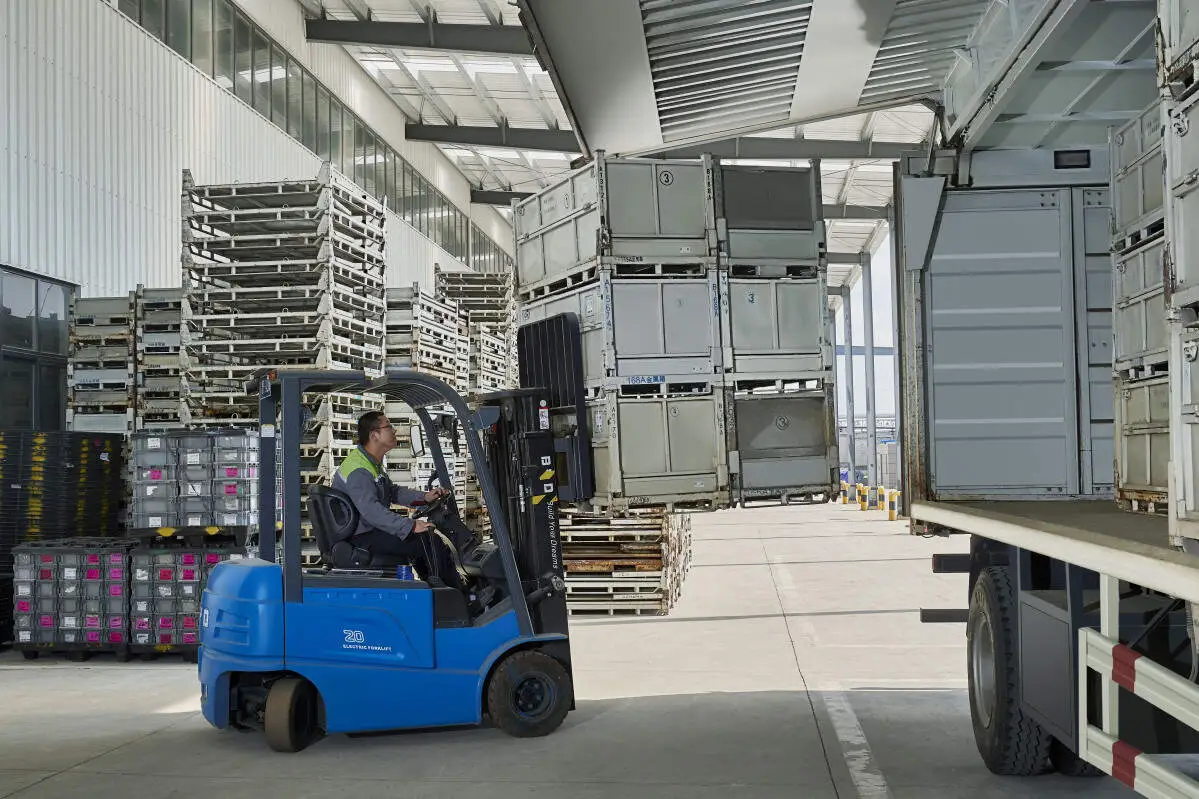
Adapt to overseas warehousing operation scenarios
Combined with storage space layout selection
The spatial layout of overseas warehouses varies widely, and narrow-channel e-commerce warehouses and large-span industrial warehouses have different requirements for forklifts. For warehouses with narrow channel widths, it is necessary to pay attention to the minimum turning radius of forklifts to ensure flexible steering in limited space and avoid work obstruction; large-span warehousing scenarios can focus on models with strong load capacity to improve the efficiency of bulk cargo handling.
Matching job type and frequency
There are differences in the performance requirements of forklifts for different types of operations. Conventional operations such as pallet loading and unloading and stacking need to ensure the lift stability and operation convenience of forklifts. In warehousing scenarios with high-frequency turnover, priority should be given to models with long battery life and continuous operation to reduce the impact of midway charging on the rhythm of operations.
Consider core performance parameters
Battery life and charging capacity
Overseas warehouses mostly use a long-term continuous operation mode, which needs to match the corresponding capacity of lithium batteries according to the average daily operation time, and pay attention to charging efficiency. The fast charging function can effectively shorten the downtime and improve the overall operation efficiency. In addition, some overseas warehouses may lack professional charging sites, so it is necessary to choose a charging mode suitable for ordinary power supplies to reduce the cost of site transformation.
Load and lift indicators
When selecting a model, it is necessary to determine the appropriate load range and lift height based on the weight and shelf height of the commonly used goods in the warehouse. If the warehouse is mainly heavy goods, it is necessary to choose a model with a higher load level to avoid overload operations affecting the life of the equipment; in scenarios with high shelf heights, it is necessary to ensure that the lift height of the forklift can cover the top layer of the shelf to meet the stacking needs.
Assessing operations and long-term costs
Battery life and ease of maintenance
The number of battery cycles of a lithium-ion forklift directly affects the service life of the equipment. When selecting a model, you can pay attention to the cycle life parameters of the battery and give priority to the model with better durability. In addition, the maintenance resources of overseas warehousing are relatively limited. It is necessary to choose a forklift with a simple structure and universal wearing parts to reduce the difficulty of daily maintenance and the cost of purchasing accessories.
Life Cycle Costing
In addition to the cost of equipment procurement, it is also necessary to calculate the long-term use of electricity, maintenance, parts replacement costs, etc. Compared with traditional fuel forklifts, lithium-ion forklifts have more advantages in energy costs, but they need to combine local electricity prices and maintenance resources to comprehensively evaluate the full life cycle cost and select a more cost-effective model.
Balancing compliance and localization
Meet overseas safety standards
Different countries and regions have clear safety standards for industrial vehicles. When selecting models, it is necessary to ensure that forklifts pass local authoritative certifications to avoid affecting normal use due to compliance issues. At the same time, it is necessary to pay attention to the safety configuration of forklifts, such as anti-collision warning, braking system, etc., to improve operational safety.
Localized after-sales support considerations
Overseas storage is far away from China, and the timeliness of maintenance after equipment failure is crucial. When selecting a model, it is necessary to understand the local after-sales network coverage to ensure that maintenance services and parts supply can be quickly obtained, and the loss caused by equipment downtime can be reduced.


