
 简体中文
简体中文 繁体中文
繁体中文 Deutsch
 日本語
日本語 한국어
한국어 Tiếng Việt
 Русский
 ไทย
ไทย Bahasa Indonesia
 Bahasa Melayu
 Filipino
 لالعربية
 Français

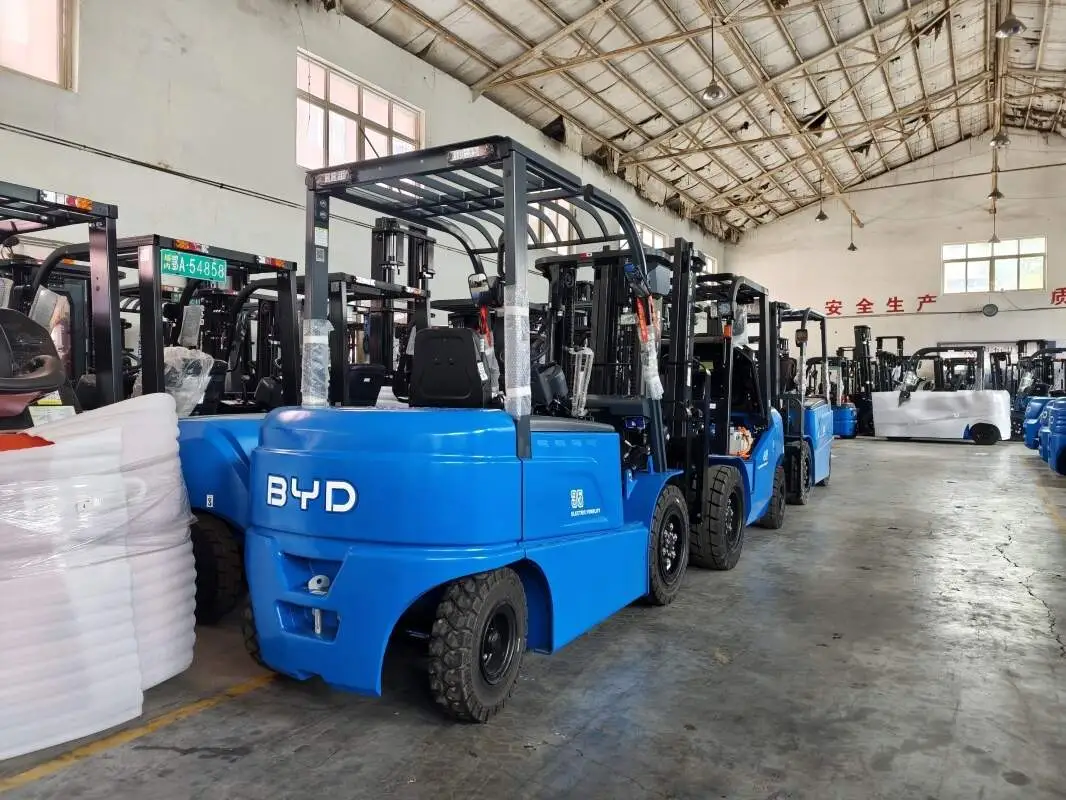
With the increasing demand for green and efficient equipment in the field of industrial logistics, the scale of the new energy forklift market continues to expand. With its unique performance advantages, the balanced lithium-ion forklift has gradually become the core category of market attention, and its development trend is also showing a trend of multiple upgrades.
Technology iteration: double upgrade of performance and intelligence
Battery technology continues to be optimized
At present, the battery technology of the balance heavy lithium battery forklift is developing in the direction of high energy density and long cycle life. Through the improvement of battery cell materials, the energy density of the battery is gradually increased, which can provide a longer range for the forklift under the same volume and meet the needs of long-term continuous operation. At the same time, the application of fast charging technology is also becoming more and more mature, which greatly shortens the charging waiting time and improves the efficiency of the equipment.
Intelligent functions are continuously integrated
In order to adapt to the development rhythm of smart logistics, heavy-duty lithium-ion forklifts are gradually incorporating various intelligent functions. For example, forklifts equipped with automatic navigation systems can achieve autonomous path planning and reduce manual operation errors; real-time status monitoring functions can collect and analyze data such as battery power and operation failures, early warning of potential problems, and reduce equipment operation and maintenance costs.
Application scenarios: expanding from indoor to diverse scenarios
Deepening the application of traditional warehousing scenarios
In the field of warehousing and logistics, the balance heavy lithium forklift has become the main equipment for indoor operations due to its advantages of zero emissions and low noise. Its flexible steering performance and stable load capacity can adapt to complex storage environments such as narrow alleys and high shelves, and improve the efficiency of cargo handling.
Breakthrough in outdoor heavy duty operation scenarios
With the improvement of battery performance, counterweight lithium-ion forklifts have begun to expand to outdoor heavy-duty operation scenarios. In ports, mines, large manufacturing plants and other scenarios, lithium-ion forklifts can replace traditional fuel forklifts to complete heavy-duty cargo handling tasks, meeting both high load requirements and green environmental protection requirements.
Policy and Markets: Accelerating Adoption Driven by Dual Drives
Green policy guidance
The promotion of domestic dual-carbon targets and the introduction of environmental protection policies for non-road mobile machinery in various places have prompted enterprises to accelerate the replacement of highly polluting fuel forklifts and switch to more environmentally friendly counterweight lithium-ion forklifts. Relevant subsidy policies also provide support for enterprises to purchase lithium-ion forklifts, further lowering the application threshold.
Enterprise cost reduction demand
From the perspective of long-term use cost, the energy consumption cost of balanced heavy lithium forklifts is lower than that of fuel forklifts, and the maintenance process is easier, which can save a lot of operating expenses for enterprises. This cost advantage has made more and more companies willing to choose lithium forklifts, which has promoted the popularity of the market.
Future Outlook: Integrated and Circular Development
Equipment integrated design
In the future, the balanced heavy-duty lithium-ion forklift will develop towards the integrated design of the whole machine, with a higher degree of integration between the battery and the body structure, which will not only improve the stability of the equipment, but also further optimize the space utilization and adapt to more special operating scenarios.
The battery recycling system is perfect
With the increase in the number of lithium-ion forklifts, the recycling of batteries will become the focus of the industry. A complete battery recycling, dismantling and cascade utilization system will be gradually established, which will not only reduce resource waste, but also further reduce the life cycle cost of equipment and promote the sustainable development of the industry.


