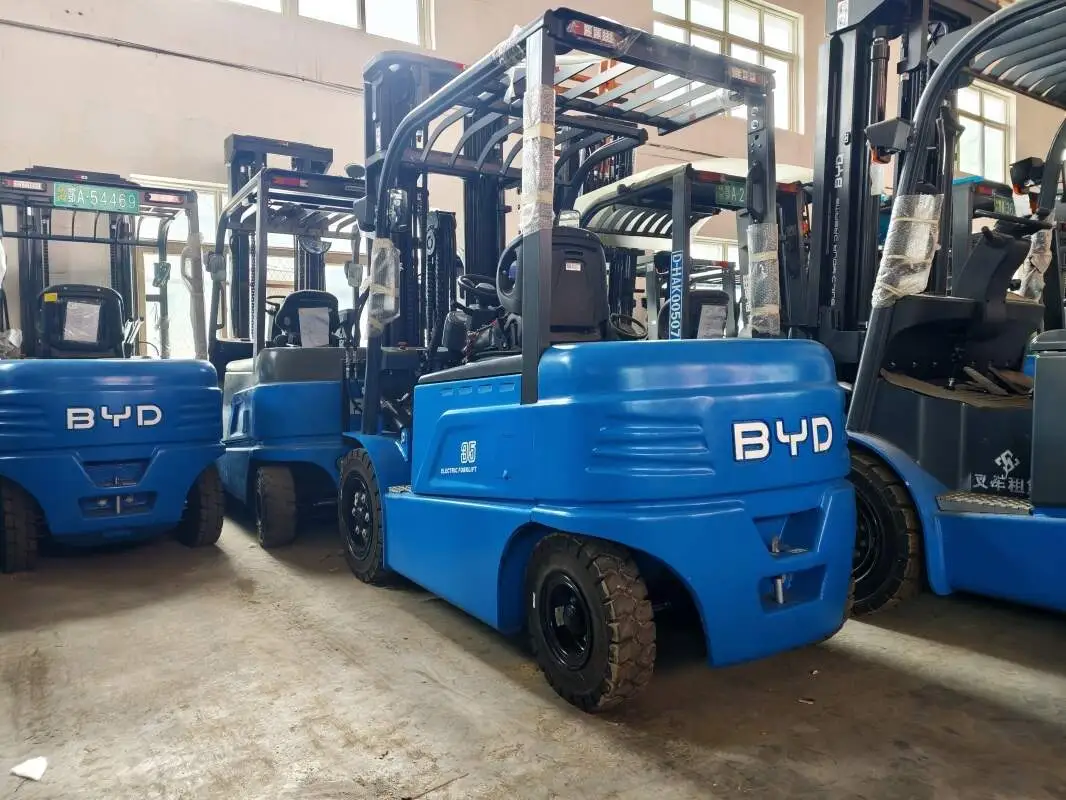
Auswahlschema und Anleitung für die Laserführung des BYD RTR16i Dreiwegestaplers

2026-07-03

Auswahlschema und Anleitung für die Laserführung des BYD RTR16i Dreiwegestaplers(Figur1)

Im Lager- und Logistikbetrieb ist der effiziente Betrieb eines Dreiwegestaplers untrennbar mit einem präzisen Führungssystem verbunden. Die Laserführung als häufig verwendete intelligente Führungsmethode kann die Arbeitsgenauigkeit und Effizienz des Staplers verbessern. Im Folgenden werden die Laserführungsoptionen und Einsatzmethoden des BYD RTR16i Dreiwegestaplers im Detail erläutert.

Option

Anwendbarer Szenarienabgleich

Es gibt Unterschiede in der Nachfrage nach Laserführung in verschiedenen Lagerumgebungen, und es ist notwendig, die Layout-Merkmale des Lagerplatzes vor der Auswahl zu bestätigen. Wenn der Lagerkanal schmal und das Regal dicht angeordnet ist, sollte der Anpassung von Laserführungskomponenten mit genauer Positionierung in einem kleinen Bereich Priorität eingeräumt werden; wenn der Betriebsbereich offen ist und der Laderaum verstreut ist, kann eine breitere Abdeckungskonfiguration gewählt werden, um sicherzustellen, dass der Stapler in verschiedenen Szenarien stabil arbeiten kann.

Anleitung zur Konfiguration der Komponenten

Das Laserführungssystem besteht hauptsächlich aus einem Laserscanner, einem Reflektor und einem Steuermodul. Bei der Auswahl sollte der Laserscanner der entsprechenden Spezifikation entsprechend der Arbeitslast und der Laufgeschwindigkeit des Staplers ausgewählt werden, um sicherzustellen, dass die Abtastgenauigkeit und die Reaktionsgeschwindigkeit den Anforderungen des Betriebs entsprechen. Die Anzahl und die Einbauposition der Reflektoren müssen mit der tatsächlichen Planung des Standorts kombiniert werden, in der Regel an den Ecken des Kanals und den Schlüsselknoten des Laderaums, um einen stabilen Empfang des Lasersignals zu gewährleisten.

Bestätigung der Anpassungsparameter

Nach Abschluss der Auswahl der Komponenten müssen die Parameter des Führungssystems angepasst und eingestellt werden, einschließlich der Abtastfrequenz, des Schwellenwerts für die Positioniergenauigkeit usw. Die Parametereinstellungen müssen mit den tatsächlichen Bedürfnissen der Lagerhaltung übereinstimmen. So können beispielsweise bei der Lagerung und dem Zugriff mit hohen Genauigkeitsanforderungen die Abtastfrequenz und die Positioniergenauigkeit entsprechend verbessert werden; bei der Übertragung über große Entfernungen können die Parameter angepasst werden, um die Betriebseffizienz zu verbessern.

Gebrauchsanweisung

Die wichtigsten Punkte der frühen Fehlersuche

Vor der Inbetriebnahme muss die Fehlersuche am Laserführungssystem abgeschlossen werden. Bestätigen Sie zunächst die Installationsfestigkeit und Positionsgenauigkeit der Reflexionsplatte, um Positionierungsfehler zu vermeiden, die durch die Abweichung der Reflexionsplatte verursacht werden; führen Sie zweitens Leerlaufübungen durch, um die Positionierungsgenauigkeit des Staplers in verschiedenen Bereichen zu ermitteln. Bei einer Abweichung müssen die Parameter oder die Position der Reflexionsplatte rechtzeitig angepasst werden; simulieren Sie schließlich die tatsächliche Betriebsszene, um die Betriebsstabilität des Systems unter Last zu überprüfen.

Täglicher Betriebsprozess

Im täglichen Gebrauch muss der Bediener zuerst das Laserführungssystem starten und dann den Stapler starten, nachdem das System den Selbsttest abgeschlossen hat und normal angezeigt wird. Achten Sie während des Betriebs auf die Positionierungsanweisungen des Systems. Wenn es eine Signalunterbrechung oder eine abnormale Positionierung gibt, stoppen Sie den Betrieb sofort und überprüfen Sie das Problem. Schalten Sie nach Abschluss des Vorgangs das Laserführungssystem aus, um sicherzustellen, dass sich das Gerät im Standby-Zustand befindet.

Vorsichtsmaßnahmen bei der Wartung

Regelmäßige Wartung ist der Schlüssel für einen stabilen Betrieb des Laserführungssystems. Überprüfen Sie jede Woche die Sauberkeit des Laserscanners, um zu vermeiden, dass Staub oder Schmutz das Lasersignal blockieren; überprüfen Sie den Reflektor jeden Monat, um sicherzustellen, dass seine Oberfläche nicht abgenutzt ist und seine Position nicht versetzt ist; kalibrieren Sie die Systemparameter jedes Quartal, um sicherzustellen, dass die Positionierungsgenauigkeit den Betriebsanforderungen entspricht. Vermeiden Sie es gleichzeitig, reflektierende Objekte in der Nähe des Laserscanners zu platzieren, um Störungen des Signalempfangs zu vermeiden.

We use cookie to improve your online experience. By continuing to browse this website, you agree to our use of cookie.

Cookies

Please read our Terms and Conditions and this Policy before accessing or using our Services. If you cannot agree with this Policy or the Terms and Conditions, please do not access or use our Services. If you are located in a jurisdiction outside the European Economic Area, by using our Services, you accept the Terms and Conditions and accept our privacy practices described in this Policy.
We may modify this Policy at any time, without prior notice, and changes may apply to any Personal Information we already hold about you, as well as any new Personal Information collected after the Policy is modified. If we make changes, we will notify you by revising the date at the top of this Policy. We will provide you with advanced notice if we make any material changes to how we collect, use or disclose your Personal Information that impact your rights under this Policy. If you are located in a jurisdiction other than the European Economic Area, the United Kingdom or Switzerland (collectively “European Countries”), your continued access or use of our Services after receiving the notice of changes, constitutes your acknowledgement that you accept the updated Policy. In addition, we may provide you with real time disclosures or additional information about the Personal Information handling practices of specific parts of our Services. Such notices may supplement this Policy or provide you with additional choices about how we process your Personal Information.


Cookies

Cookies are small text files stored on your device when you access most Websites on the internet or open certain emails. Among other things, Cookies allow a Website to recognize your device and remember if you've been to the Website before. Examples of information collected by Cookies include your browser type and the address of the Website from which you arrived at our Website as well as IP address and clickstream behavior (that is the pages you view and the links you click).We use the term cookie to refer to Cookies and technologies that perform a similar function to Cookies (e.g., tags, pixels, web beacons, etc.). Cookies can be read by the originating Website on each subsequent visit and by any other Website that recognizes the cookie. The Website uses Cookies in order to make the Website easier to use, to support a better user experience, including the provision of information and functionality to you, as well as to provide us with information about how the Website is used so that we can make sure it is as up to date, relevant, and error free as we can. Cookies on the Website We use Cookies to personalize your experience when you visit the Site, uniquely identify your computer for security purposes, and enable us and our third-party service providers to serve ads on our behalf across the internet.

We classify Cookies in the following categories:
 ●  Strictly Necessary Cookies
 ●  Performance Cookies
 ●  Functional Cookies
 ●  Targeting Cookies


Cookie List
A cookie is a small piece of data (text file) that a website – when visited by a user – asks your browser to store on your device in order to remember information about you, such as your language preference or login information. Those cookies are set by us and called first-party cookies. We also use third-party cookies – which are cookies from a domain different than the domain of the website you are visiting – for our advertising and marketing efforts. More specifically, we use cookies and other tracking technologies for the following purposes:

Strictly Necessary Cookies
These cookies are necessary for the website to function and cannot be switched off in our systems. They are usually only set in response to actions made by you which amount to a request for services, such as setting your privacy preferences, logging in or filling in forms. You can set your browser to block or alert you about these cookies, but some parts of the site will not then work. These cookies do not store any personally identifiable information.

Functional Cookies
These cookies enable the website to provide enhanced functionality and personalisation. They may be set by us or by third party providers whose services we have added to our pages. If you do not allow these cookies then some or all of these services may not function properly.

Performance Cookies
These cookies allow us to count visits and traffic sources so we can measure and improve the performance of our site. They help us to know which pages are the most and least popular and see how visitors move around the site. All information these cookies collect is aggregated and therefore anonymous. If you do not allow these cookies we will not know when you have visited our site, and will not be able to monitor its performance.

Targeting Cookies
These cookies may be set through our site by our advertising partners. They may be used by those companies to build a profile of your interests and show you relevant adverts on other sites. They do not store directly personal information, but are based on uniquely identifying your browser and internet device. If you do not allow these cookies, you will experience less targeted advertising.

How To Turn Off Cookies
You can choose to restrict or block Cookies through your browser settings at any time. Please note that certain Cookies may be set as soon as you visit the Website, but you can remove them using your browser settings. However, please be aware that restricting or blocking Cookies set on the Website may impact the functionality or performance of the Website or prevent you from using certain services provided through the Website. It will also affect our ability to update the Website to cater for user preferences and improve performance. Cookies within Mobile Applications

We only use Strictly Necessary Cookies on our mobile applications. These Cookies are critical to the functionality of our applications, so if you block or delete these Cookies you may not be able to use the application. These Cookies are not shared with any other application on your mobile device. We never use the Cookies from the mobile application to store personal information about you.

If you have questions or concerns regarding any information in this Privacy Policy, please contact us by email at . You can also contact us via our customer service at our Site.