
 简体中文
简体中文 繁体中文
繁体中文 Deutsch
 日本語
日本語 한국어
한국어 Tiếng Việt
 Русский
 ไทย
ไทย Bahasa Indonesia
 Bahasa Melayu
 Filipino
 لالعربية
 Français

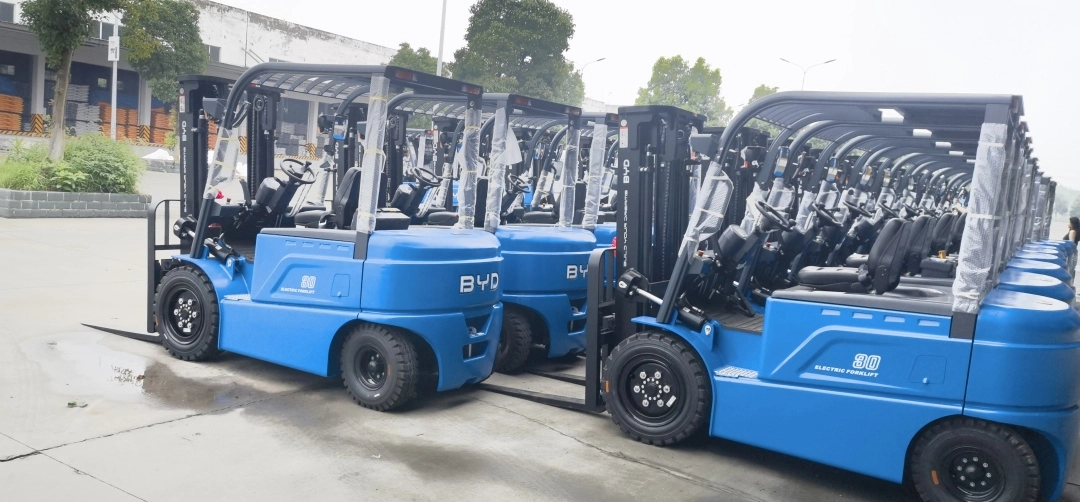
In modern warehousing and logistics systems, three-way stacking forklifts have become the core equipment for narrow-channel and high-density storage scenarios with their flexible steering capabilities and efficient stacking efficiency. The performance of different brands of products under various working conditions varies. Comparative analysis of these differences can help enterprises choose equipment that suits their own needs more accurately. Among them, the comprehensive performance of BYD RTR series is worth referring to.
Performance differences of three-way stacking forklifts under various working conditions
Narrow channel storage conditions
Narrow aisle is a common scene in storage operations, which requires extremely high steering radius and body flexibility of forklifts. When some products turn in narrow aisles, more operating space needs to be reserved, which is easy to affect the operation efficiency; some products will scratch the shelves in the aisle due to body width design problems, increasing the risk of equipment loss.
High density storage conditions
High-density storage requires forklifts to be accurately lifted to high-level shelves while maintaining stability. When some products are stacked at high levels, the body shakes a lot, which not only affects the accuracy of cargo placement, but also poses safety hazards; some products have a slow lifting speed, making it difficult to meet the rapid turnover requirements in high-density storage scenarios.
Frequent start and stop operation conditions
In scenarios with frequent starts and stops, such as e-commerce warehousing, the power response and energy consumption performance of forklifts are crucial. Some products have unstable power output during frequent starts and stops, which is prone to card phenomena and affects the smoothness of operations; some products consume more energy under such conditions, increasing long-term use costs.
Comprehensive performance reference of BYD RTR series
Narrow channel adaptability
The BYD RTR series has optimized the steering system for narrow channel scenarios, with a smaller steering radius and a body width designed to fit the channel requirements. It can accurately control the space when steering and moving in the narrow channel, reduce the risk of scratches, improve the smoothness of the operation, and adapt to most standard narrow channel storage environments.
High density storage stability
This series of products is equipped with a stable lifting system when stacked at high levels. The shaking amplitude of the body is controlled within a reasonable range, and the lifting speed is uniform and stable, which can not only ensure the accuracy of cargo placement, but also meet the turnover efficiency requirements in high-density storage scenarios and reduce safety hazards.
Energy consumption and power performance of frequent start-stop operation
In frequent start-stop operations, BYD's RTR series has a fast power response, stable output, and no card phenomenon. At the same time, its energy consumption is controlled reasonably, and long-term use can effectively reduce operating costs. It is suitable for warehousing scenarios in high-frequency operations such as e-commerce and fast-moving consumer goods.
Overall, different brands of three-way stacking forklifts perform differently under various working conditions, and enterprises need to consider the specific needs of their own warehousing scenarios when purchasing. The comprehensive performance of BYD RTR series in mainstream working conditions such as narrow aisles, high-density storage, and frequent starts and stops is balanced, providing reliable operation support for most warehousing enterprises.


