
 简体中文
简体中文 繁体中文
繁体中文 Deutsch
 日本語
日本語 한국어
한국어 Tiếng Việt
 Русский
 ไทย
ไทย Bahasa Indonesia
 Bahasa Melayu
 Filipino
 لالعربية
 Français

Key Considerations for E-commerce Warehousing Equipment Procurement
Pain points of warehousing scenarios
E-commerce warehousing generally faces the problems of large fluctuations in orders and tight storage space, especially during the big promotion period, the efficiency of goods turnover directly affects the performance speed. Many traditional warehousing equipment has the shortcomings of narrow passages and low utilization of upper shelves, which cannot adapt to the dual needs of high-density storage and fast operation. Therefore, in the stage of equipment procurement, it is necessary to focus on the space adaptation of equipment, operational flexibility and long-term operating costs.
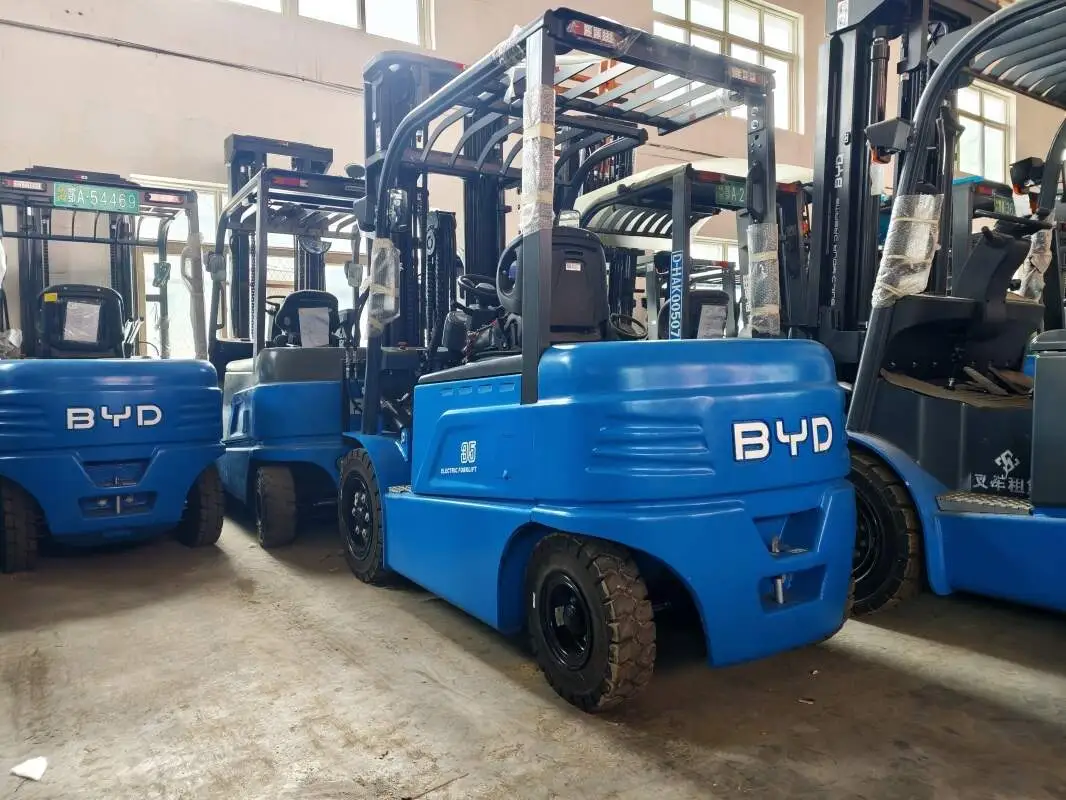
Floor Adaptation of BYD R16P Reach Forklift
Customized adjustment of on-site layout
Aiming at the narrow channel layout and high-rise shelf design of the target warehouse, the forward forklift made targeted parameter adjustments before landing, optimized the fork arm telescopic stroke and minimum turning radius, and ensured that it could steer flexibly within the 1.8-meter-wide channel and reach the 8-meter-high upper cargo space smoothly. At the same time, according to the pallet specifications of the warehoused goods, the fork tooth spacing was adjusted to adapt to the storage needs of different sizes of goods.
Adaptation training for operators
In order to ensure the efficient and safe operation of the equipment, the warehouse organized a 3-day special project training, covering the basic operation of the forward forklift, narrow channel operation skills, daily maintenance points, etc. The training allows operators to quickly grasp the characteristics of the equipment and reduce the operation error rate through theoretical explanation and on-site practical operation.
Operational effectiveness after landing
After 3 months of actual operation, the forward forklift has effectively improved the utilization rate of storage space. The proportion of goods storage on the upper shelf has increased from 62% to 81%, and the storage density has been significantly optimized. In terms of operational efficiency, the pick-and-place time of a single cargo space is about 16% shorter than that of a traditional forklift, and the turnover speed of goods during the big promotion period is about 21% higher. In addition, the electric drive mode reduces exhaust emissions and noise pollution, which is in line with the development trend of green storage, and the energy consumption and maintenance costs in long-term operation are also reduced to a certain extent.


