
 简体中文
简体中文 繁体中文
繁体中文 Deutsch
 日本語
日本語 한국어
한국어 Tiếng Việt
 Русский
 ไทย
ไทย Bahasa Indonesia
 Bahasa Melayu
 Filipino
 لالعربية
 Français

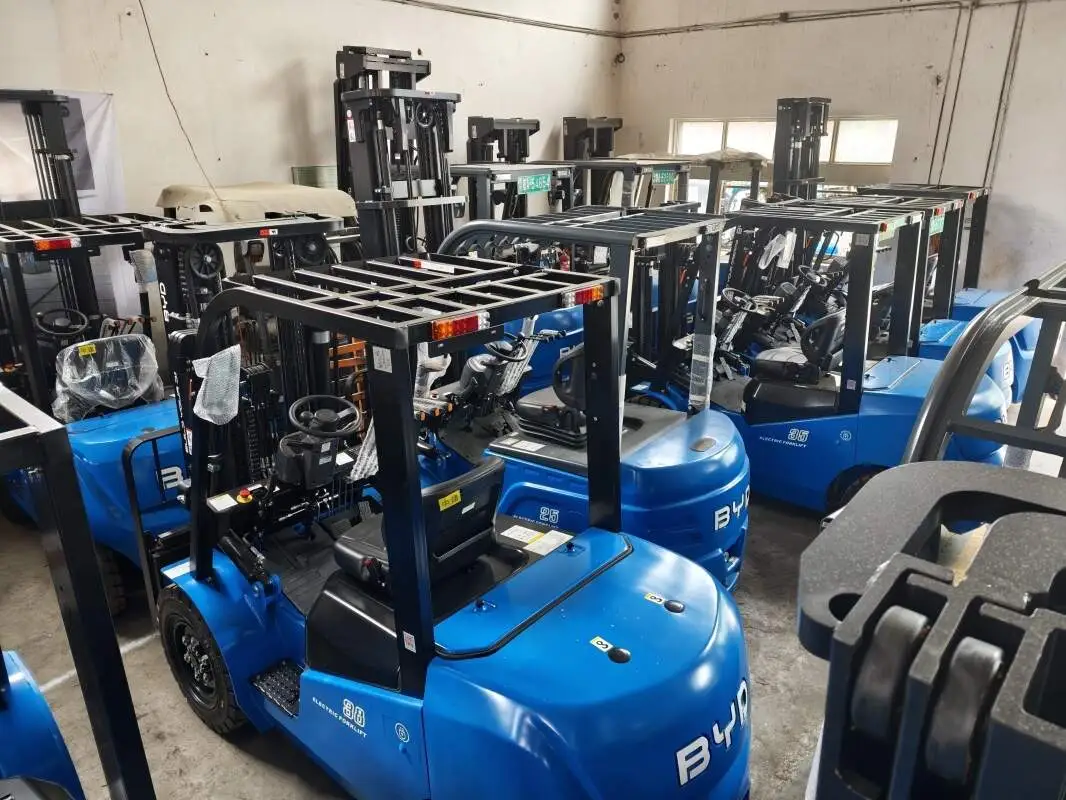
The efficiency of transshipment on the factory site directly affects the overall production rhythm. Reasonable matching of transshipment vehicles is the key to improving operational efficiency. When formulating a matching plan, three core principles need to be followed: first, match the site space, and select the corresponding size vehicle according to the channel width and turning radius; second, match the transshipment load, and determine the vehicle bearing capacity according to the weight and volume of the goods; third, match the operating frequency. In high-frequency operating scenarios, vehicles with stable battery life are preferred.
BYD Q series models are designed for different scenarios to meet diverse on-site transshipment requirements.
Small and flexible: suitable for narrow working scenarios
This model has a compact body and a small turning radius, making it easy to shuttle through narrow passages. It is suitable for scenes with limited space such as small production workshops and e-commerce sorting warehouses. It is mainly used for short-distance transshipment of light goods, such as small parts and packaged finished parts, to complete efficient handling without taking up too much space.
Balanced Utility: Adapt to normal scenarios with medium load
This model has moderate carrying capacity, stable battery life and low difficulty in operation. It is suitable for medium-sized warehouses and production lines. It can undertake tasks such as work in progress and material replenishment. It can not only cope with daily routine load requirements, but also maintain stable performance in multi-shift operations.
Heavy-duty high-efficiency model: suitable for high-load operation scenarios
This model has strong load-bearing capacity and stable power output, which can cope with the handling needs of heavy goods. It is suitable for heavy machinery workshops, raw material yards and other scenarios. It is used for handling heavy raw materials and large finished parts. It can still maintain smooth operation under heavy load operations and improve the transfer efficiency of heavy goods.
Long-distance transfer models: suitable for a wide range of factory scenarios
This model has a long cruising range and smooth driving speed, making it suitable for a wide range of operation scenarios such as large factories and logistics distribution centers. It is mainly used for long-distance bulk cargo transshipment, reducing the frequency of charging in the middle and improving the continuity of cross-regional transshipment.
When selecting a transshipment vehicle, a factory needs to consider its own site conditions, cargo characteristics, and operational requirements comprehensively, and achieve maximum efficiency in transshipment by rationally matching different types of vehicles.


