
 简体中文
简体中文 繁体中文
繁体中文 Deutsch
 日本語
日本語 한국어
한국어 Tiếng Việt
 Русский
 ไทย
ไทย Bahasa Indonesia
 Bahasa Melayu
 Filipino
 لالعربية
 Français

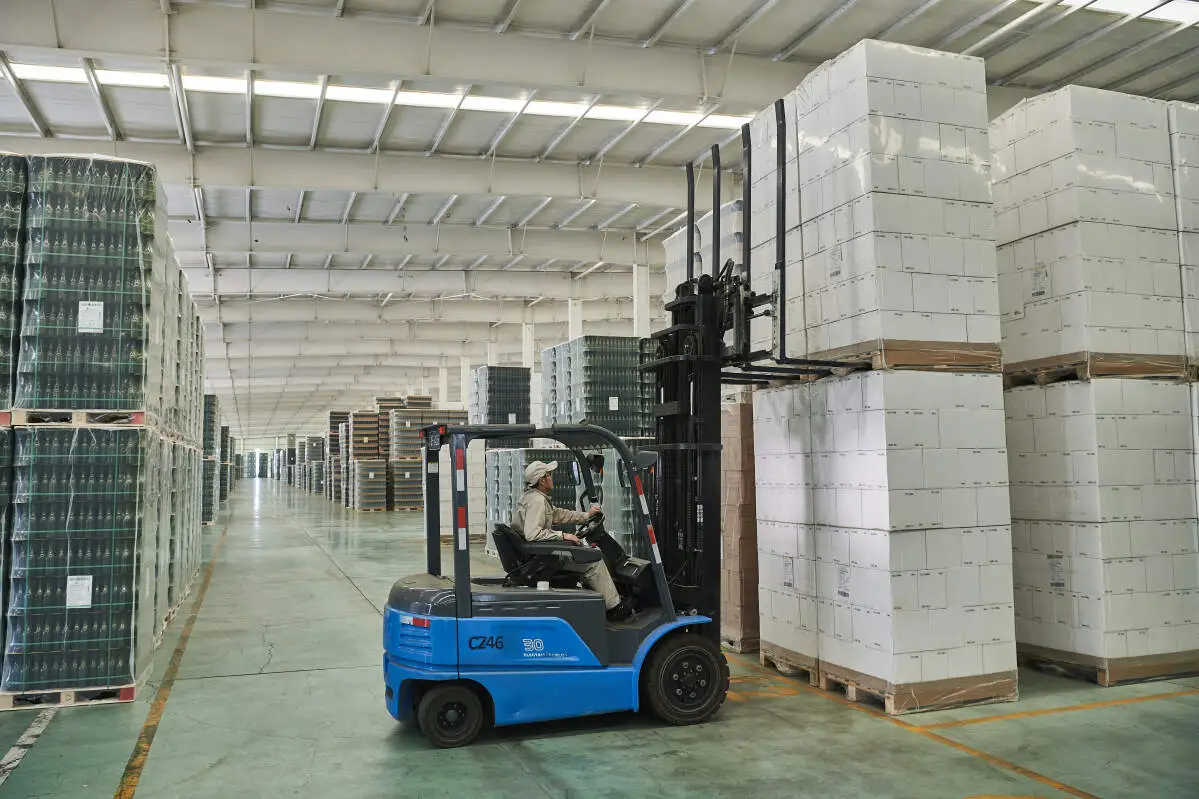
In the production and circulation of furniture factories, heavy-duty goods account for a large proportion, such as high-density particle board multi-layer boards, complete wardrobe frames, complete sets of finished sofas, etc. These goods are bulky and heavy, and some single pieces or groups can reach several tons. They have high requirements for the carrying capacity and stability of handling and stacking equipment. Previously, many furniture factories would choose internal combustion counterweight forklifts, but with the improvement of environmental protection requirements and the demand for the comfort of the working environment in the production scene, large-tonnage lithium-ion counterweight forklifts have gradually entered the field of application.
The application scenarios of large-tonnage lithium-ion counterbalanced forklifts in furniture factories are extensive. The first is the stacking operation of raw material warehouses. Wood-based panel raw materials are usually supported by wooden pallets or iron pallets. Due to changes in production plans, the weight of multi-layer high-density groups can reach 5 tons or more. Such goods need to be stacked at a higher shelf level to save storage space. The carrying capacity of large-tonnage lithium-ion counterbalanced forklifts can cover common needs, and the lifting height of the door frame can also be adapted to most general-purpose storage shelves. Secondly, the large-size finished products in the finished product warehouse are put on the shelves. The complete set of sofas or complete wardrobes is not only heavy in weight, but also may have irregular volume and offset of the center of gravity. The counterweight structure can better deal with such problems and maintain the stability of the operation process. In addition, during the transfer process in the production workshop, such as from the cutting group in the preparation workshop to the platen group, and from the painting workshop to the finished product storage area, such operations have a moderate distance but heavy cargo. The endurance of large-tonnage lithium-ion balance forklifts can usually meet the production needs of single or multiple shifts, and the usage scenarios are flexible.
Compared with internal combustion counterbalance forklifts, large-tonnage lithium-ion counterbalance forklifts have certain advantages in the application of furniture factories. It has no exhaust emissions, is suitable for operation in closed or semi-closed workshops and warehouses, can effectively improve the working environment of operators, and also meets the environmental protection regulatory requirements of most regions. At the same time, this type of forklift has low operating noise, can reduce the interference to the workshop environment, and is convenient for communication and coordination in the production process. In terms of maintenance, the components structure of large-tonnage lithium-ion counterbalance forklifts is relatively simple, and there is no tedious work such as engine-related oil replacement and filter cleaning. The daily maintenance cost and time cost are reduced.
When using large-tonnage lithium-ion counterbalance forklifts, furniture companies also need to pay attention to some key points. For example, when handling irregular heavy goods, fix the goods and confirm the position of the center of gravity to avoid the goods rollover. According to the width of the passage in the warehouse or workshop, choose the appropriate size forklift to ensure the safety of passage and stacking. It is also necessary to regularly check the battery power, body structure, door frame system and other key components, and do a good job of daily maintenance to prolong the service life of the equipment.


