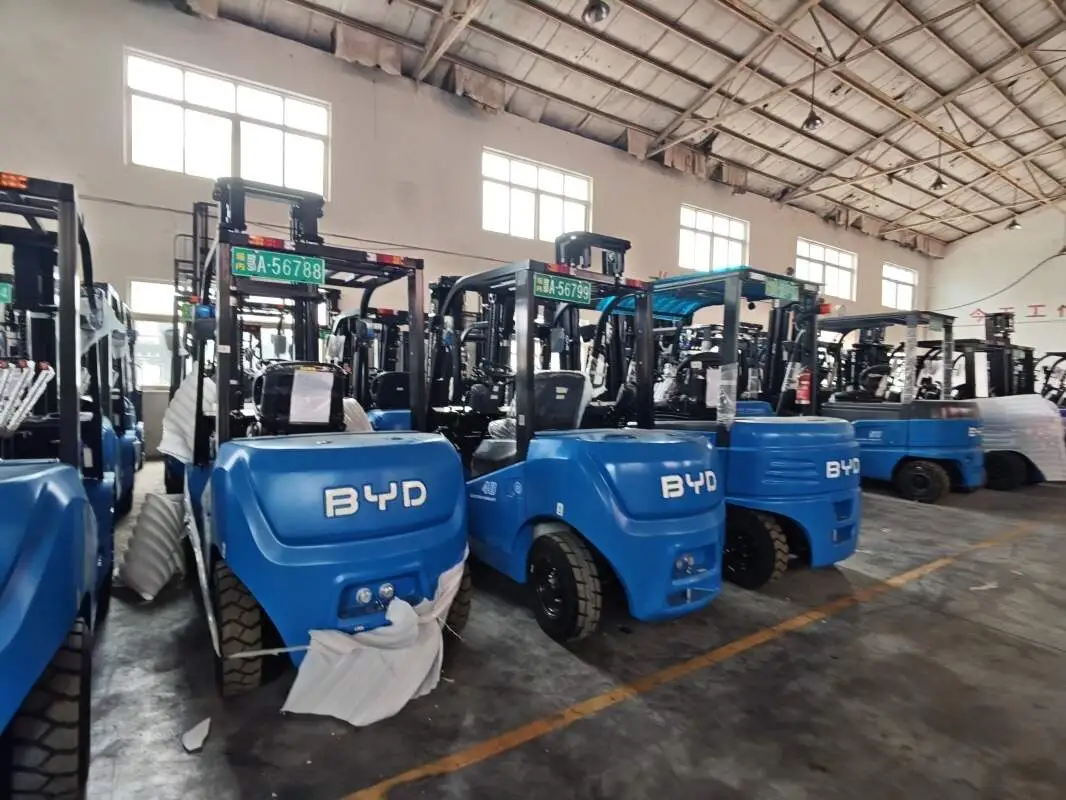
forklift tip-over incidents remain a persistent safety concern in industrial and warehouse operations, endangering operators, bystanders, and valuable inventory. While operator training and load management are critical, the built-in features of a forklift’s chassis serve as foundational safeguards against such accidents. These engineered components work in tandem to boost stability, adapt to diverse operating conditions, and reduce tip-over risks before they escalate.
Center-of-gravity optimization is a primary focus of modern forklift chassis design. By integrating strategically placed counterweights within the chassis frame rather than as external add-ons, the vehicle maintains a low, centralized center of gravity (CoG). This ensures the CoG stays within the stability triangle—defined by the front wheels and rear counterweight—during lifting, lowering, and maneuvering. Even when carrying heavy loads, the chassis’s structural integrity prevents excessive CoG shift, minimizing the risk of forward tip-overs.
Dynamic stability monitoring systems embedded in the chassis further enhance safety. Sensors and electronic control units (ECUs) continuously track real-time data such as load weight, lift height, travel speed, and steering angle. If the system detects the forklift approaching a stability threshold—for example, turning sharply with raised forks—it triggers visual and auditory alerts for the operator. In some cases, it may automatically adjust performance parameters, like limiting lift height or reducing travel speed, to restore stable operation before a tip-over can occur.
Uneven floor surfaces are a common tip-over trigger, which is why automatic chassis leveling features are integrated into many electric forklift chassis. Hydraulic or pneumatic components within the chassis adjust individual wheel heights in real time, keeping the vehicle level on sloped or uneven ground. This maintains load stability during transport and preserves the integrity of the stability triangle, preventing lateral tip-overs that often happen on inclines.
Speed and steering control mechanisms in the chassis also play a key role. When a forklift carries a full load or operates with raised forks, the chassis’s ECU automatically limits maximum travel speed. Steering sensitivity is adjusted during high-speed maneuvers or heavy load handling, reducing sudden momentum shifts that could lead to tip-overs. These features complement operator inputs, adding safety without compromising operational efficiency.
Finally, reinforced chassis structures contribute to tip-over mitigation. High-strength steel alloys construct the frame, offering rigidity to resist torsion and bending under heavy loads. Reinforced cross-members and support beams distribute weight evenly, preventing structural deformation that could alter the vehicle’s stability profile. This robust design ensures the chassis retains its safety characteristics even in demanding environments.
In conclusion, built-in chassis features are essential to a comprehensive safety strategy for forklift tip-over mitigation. From CoG optimization to real-time monitoring and automatic adjustments, these elements work together to enhance stability, adapt to challenges, and protect personnel and assets. Prioritizing these chassis safety features helps operations significantly reduce tip-over risks and foster safer working environments.