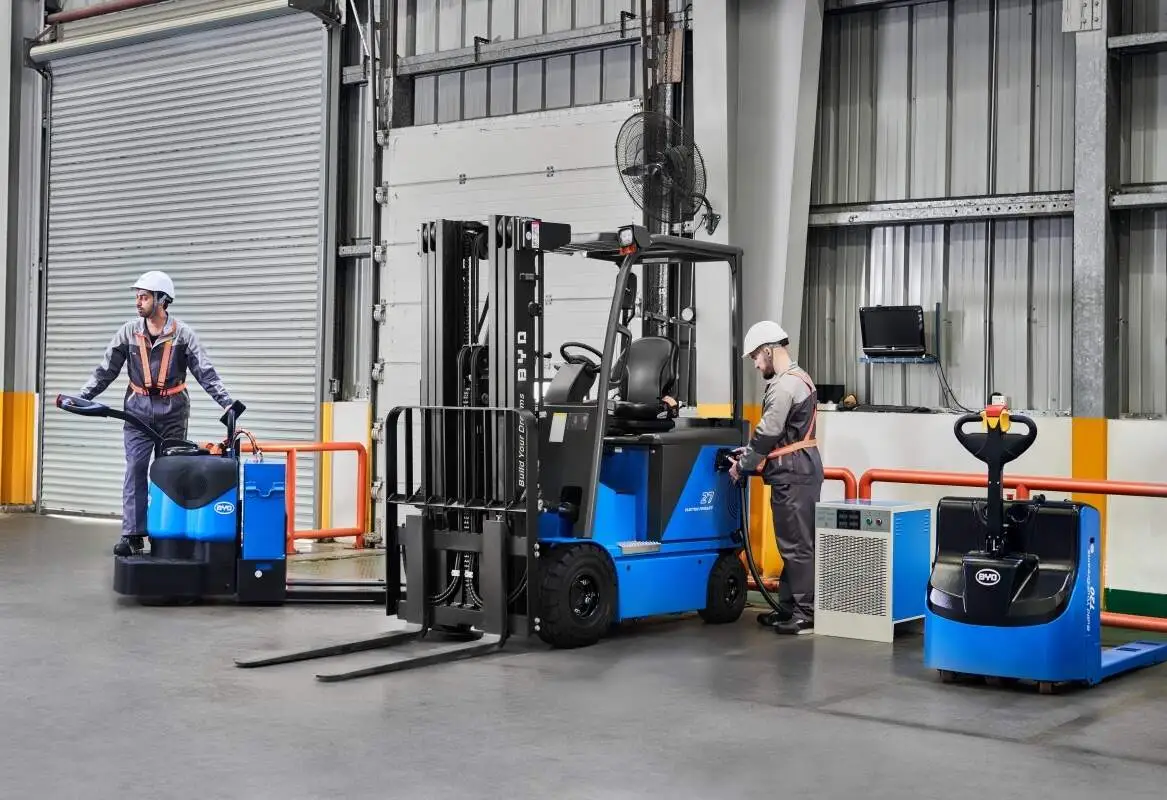
7-ton standard forklifts play a pivotal role in heavy-duty material handling across industries like manufacturing, warehousing, and logistics. Understanding their precise dimensions is not just a matter of equipment selection—it directly impacts operational efficiency, safety, and compatibility with existing facility layouts. This guide outlines key dimension references for standard 7-ton forklift models to help operators, fleet managers, and facility planners make informed decisions.
The overall length of a 7-ton standard forklift typically ranges from 4.5 to 5.2 meters, measured from the front of the forks (in fully retracted position) to the rear of the counterweight. This length accounts for the counterweight’s necessary size to balance the 7-ton load capacity. The overall width, excluding attachments, generally falls between 1.2 to 1.4 meters, ensuring maneuverability through standard warehouse aisles while maintaining stability during heavy lifts. Overall height varies based on mast configuration: a standard two-stage mast reaches approximately 2.5 to 2.8 meters when fully lowered, and up to 4.8 to 5.5 meters when fully extended to lift loads to higher storage racks.
Fork dimensions are critical for secure load handling. Standard forks for 7-ton models usually have a length of 1.2 to 1.5 meters, with a thickness ranging from 50 to 60 millimeters and width of 120 to 150 millimeters, providing sufficient strength to support heavy loads. The load center, defined as the distance from the face of the forks to the center of gravity of the load, is standardized at 600 millimeters for most 7-ton forklifts. Adhering to this load center is essential to prevent tip-over incidents and ensure the forklift operates within its rated capacity.
A key dimension for navigating tight spaces is the turning radius. 7-ton standard forklifts typically have an outer turning radius of 3.2 to 3.8 meters, while the inner turning radius (measured from the center of the rear axle to the closest point on the forklift during a turn) ranges from 1.5 to 1.8 meters. This allows the forklift to maneuver through aisles that are at least 3.5 to 4 meters wide, making it suitable for most mid-sized warehouses and industrial facilities. Operators should consider this dimension when planning aisle layouts to avoid bottlenecks and ensure smooth traffic flow.
Ignoring these dimension references can lead to a range of operational issues. For example, a forklift with excessive length may struggle to fit into loading docks or narrow storage areas, while incorrect fork dimensions can result in unstable load handling, increasing the risk of accidents. Facility planners must cross-reference these measurements with their space constraints, such as ceiling heights, aisle widths, and loading dock clearances, to select the right model. Regularly verifying dimensions during pre-operation checks also helps ensure safe and efficient daily operations.
In summary, understanding the key dimension references for 7-ton standard forklift models is fundamental to optimizing material handling operations. By considering overall exterior dimensions, fork specifications, load center, and turning radius, businesses can select equipment that aligns with their facility needs, enhances safety, and boosts productivity. Whether you’re expanding your fleet or upgrading your facility, these measurements serve as a reliable guide to make well-informed choices.