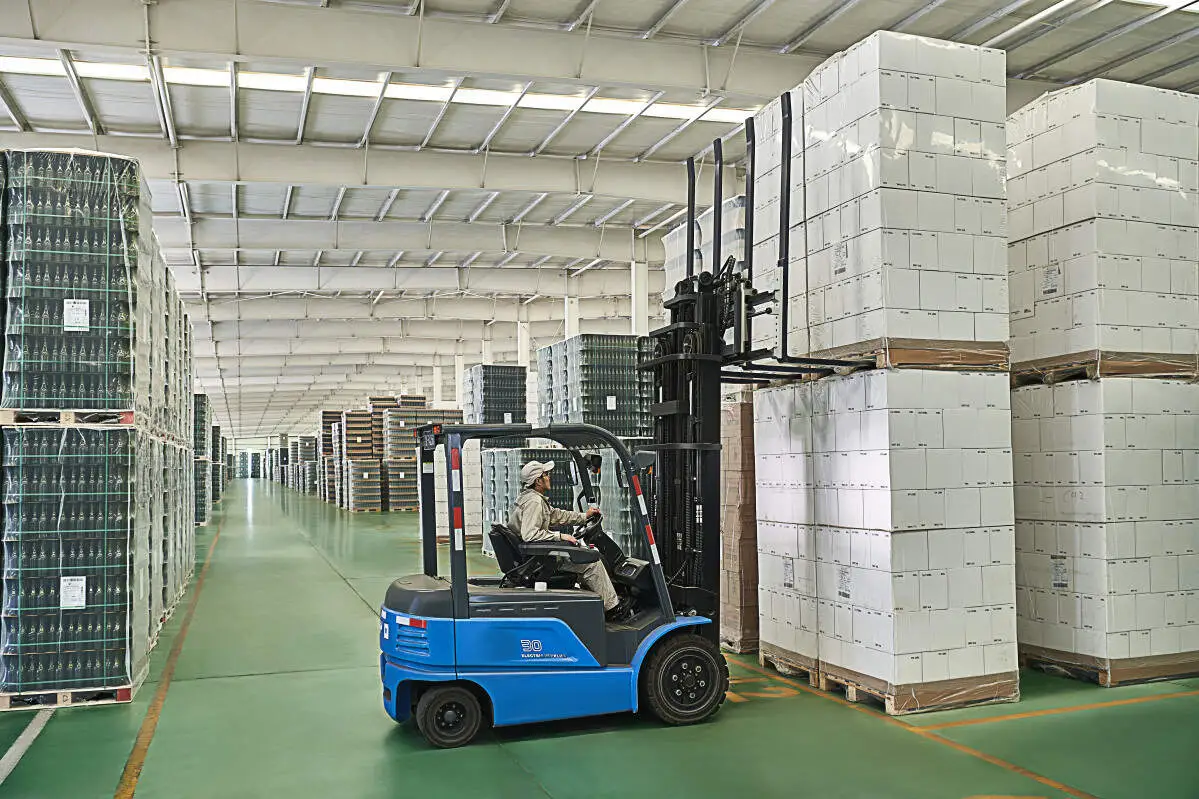
In industrial and warehouse operations, forklifts are indispensable tools for moving heavy loads efficiently, but their utility comes with inherent safety risks. Among the most fundamental concepts ensuring safe forklift operation is the stability triangle—a core principle that every operator must master to prevent tip-overs and protect both personnel and assets.
The stability triangle is formed by three key points on a forklift: the two front wheels and the center of the rear axle. This triangular area defines the safe zone where the forklift’s combined center of gravity (CoG)—including the machine itself and any loaded cargo—must remain at all times. When the CoG stays within this triangle, the forklift maintains balance; if it shifts outside, the risk of a tip-over rises dramatically.
Understanding how load handling affects the center of gravity is critical. An empty forklift has a CoG positioned near the rear of the triangle, providing a wide margin of stability. However, when a load is lifted, the CoG shifts forward and upward, narrowing this margin. The higher the load is raised, the more unstable the forklift becomes, as the CoG moves closer to the front edge of the triangle. Even slight shifts, such as tilting the mast too far forward or carrying an unevenly distributed load, can push the CoG outside the safe zone.
Several external and operational factors can compromise the stability triangle. Uneven or sloped ground, for example, tilts the triangle’s plane, reducing the effective safe area and making it easier for the CoG to slip outside. Sudden turns, acceleration, or braking can cause lateral or forward shifts in the CoG, especially when carrying heavy loads. Overloading the forklift beyond its rated capacity also moves the CoG too far forward, eliminating any remaining stability buffer.
To uphold the stability triangle principle, operators must follow strict safe handling protocols. Before each use, pre-operation checks should confirm that the forklift is in good working condition, with properly inflated tires and functional brakes. Operators must calculate the load’s weight and ensure it is evenly distributed on the forks, avoiding overhang that could shift the CoG excessively. When traveling, loads should be kept as low as possible to minimize upward CoG movement, and sudden maneuvers should be avoided entirely. Operating on flat, stable ground whenever possible is another key practice, as sloped surfaces significantly increase tip-over risk.
Mastering the stability triangle is not just a best practice—it is a non-negotiable component of safe forklift operation. By understanding how the center of gravity interacts with this triangular safe zone, operators can make informed decisions that prevent accidents, reduce downtime, and create a safer workplace. Regular training on this core principle ensures that all personnel recognize the importance of the stability triangle and apply it consistently in every load-handling task.