In the fast-paced world of warehouse operations, efficient material handling is the backbone of smooth daily workflows. Choosing the right equipment can significantly impact productivity, safety, and operational costs. Two essential tools for these tasks are hand trucks and forklifts, each with unique strengths suited to different scenarios. Understanding their options and ideal use cases helps warehouse managers make informed decisions tailored to their specific needs.
Hand trucks come in various designs to accommodate different material handling needs. Manual hand trucks, the most basic type, are ideal for moving small, lightweight loads over short distances. They are compact, easy to maneuver through narrow aisles, and require no power source, making them a cost-effective choice for routine tasks like moving boxes or small crates. Electric hand trucks, on the other hand, offer enhanced functionality for heavier loads or longer distances. Equipped with a battery-powered motor, they reduce physical strain on workers and can handle heavier items such as stacked pallets or large containers. These are particularly useful in facilities where frequent lifting and moving are required, without the need for the larger footprint of a forklift.
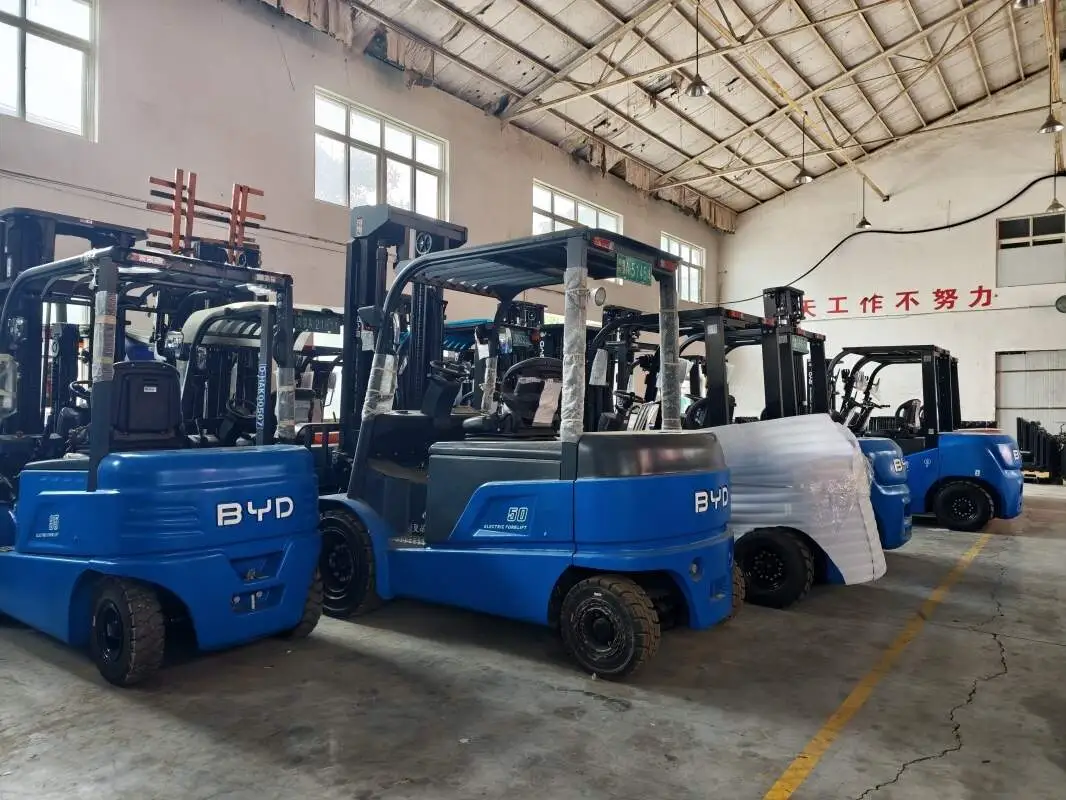
Forklifts are the workhorses of larger-scale warehouse material handling, designed to handle heavy loads and reach elevated storage areas. Counterbalance forklifts are the most common type, suitable for general-purpose tasks like loading and unloading trucks and moving pallets across open warehouse spaces. Reach forklifts, with their extendable arms, are perfect for accessing high shelves in narrow aisles, maximizing vertical storage space. electric forklifts are gaining popularity due to their low emissions and quiet operation, making them ideal for indoor warehouses where air quality and noise levels are a concern. For outdoor tasks, gas or diesel-powered forklifts offer greater power and range, handling uneven terrain and heavier loads with ease.
When deciding between hand trucks and forklifts, several key factors must be considered. First, the weight and size of the loads being moved play a crucial role. Hand trucks are best for loads under a few hundred pounds, while forklifts can handle thousands of pounds. The layout of the warehouse is another important factor; narrow aisles and tight spaces favor hand trucks or compact forklift models, while open areas allow for larger, more powerful forklifts. Additionally, the distance of the move matters: hand trucks are efficient for short trips, whereas forklifts excel at transporting heavy loads over longer distances. Budget is also a consideration, as manual hand trucks have lower upfront costs, while electric forklifts require a larger investment but offer long-term efficiency gains. Finally, operator training is essential—forklifts require certified operators, while hand trucks are easy to use with minimal training.
By evaluating these factors, warehouse managers can select the right combination of hand trucks and forklifts to optimize their material handling operations. Whether it’s the flexibility of a hand truck for small tasks or the power of a forklift for heavy-duty work, choosing the appropriate equipment ensures that operations run smoothly, safely, and efficiently, supporting overall business success.