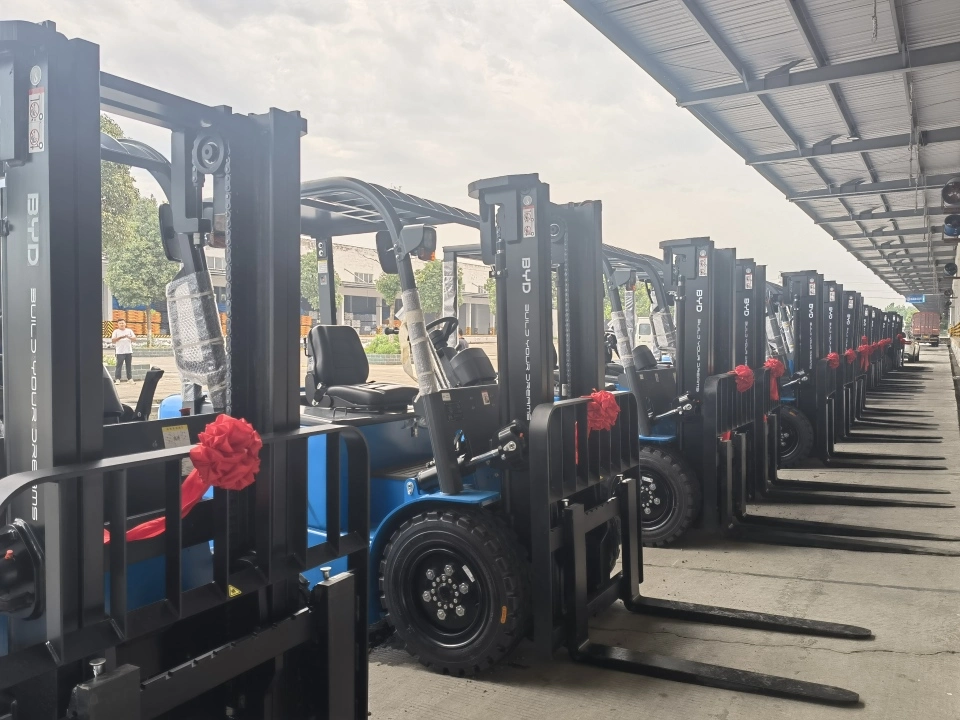
Forklifts are indispensable tools in material handling, where operational stability directly impacts safety, efficiency, and productivity. Among the many factors determining a forklift’s stability, overall weight stands out as a critical element that influences multiple aspects of its performance. Understanding this relationship is essential for operators, fleet managers, and safety professionals to ensure secure and smooth daily operations.
The overall weight of a forklift includes its base weight and the weight of the load it carries. A properly balanced overall weight ensures that the forklift’s center of gravity remains within safe limits during operation. If the base weight is too light relative to the load, the forklift risks tipping forward when lifting heavy items, especially at maximum lift height. Conversely, an excessively heavy base weight can shift the center of gravity too far backward, reducing maneuverability and increasing the risk of tipping during sharp turns or uneven terrain traversal. Finding the right balance between base weight and load capacity is key to maintaining stable lifting and lowering operations.
Overall weight also plays a vital role in how a forklift adapts to different terrains. On flat, smooth surfaces, a moderate overall weight provides sufficient traction without unnecessary strain on the tires and suspension. However, when operating on slopes or uneven ground, a slightly heavier overall weight can enhance grip, reducing the chance of slipping or sliding. That said, an overly heavy forklift may struggle with traction on soft surfaces like gravel or grass, as the excess weight can cause the tires to sink, leading to instability and increased fuel consumption. Operators must adjust their driving style based on the forklift’s overall weight and the terrain to maintain stability.
Maneuverability and braking performance are closely tied to a forklift’s overall weight. A heavier forklift typically has a longer braking distance, requiring operators to allow more space to stop safely, especially when carrying heavy loads. On the other hand, a lighter forklift may be more agile in tight spaces but can be prone to swaying during sudden turns. The overall weight also affects steering precision—too light, and the forklift may feel unstable at higher speeds; too heavy, and steering can become stiff, increasing the risk of operator fatigue. Balancing overall weight to match the operational environment ensures that the forklift remains responsive while maintaining stability.
In conclusion, forklift overall weight is a foundational factor that shapes operational stability across various scenarios. By understanding how weight interacts with load balancing, terrain adaptation, and maneuverability, stakeholders can make informed decisions when selecting forklifts, training operators, and implementing safety protocols. Regular inspections to ensure the forklift’s weight configuration matches its intended use, along with operator training on weight-related stability best practices, are essential for minimizing risks and maximizing operational efficiency in material handling settings.