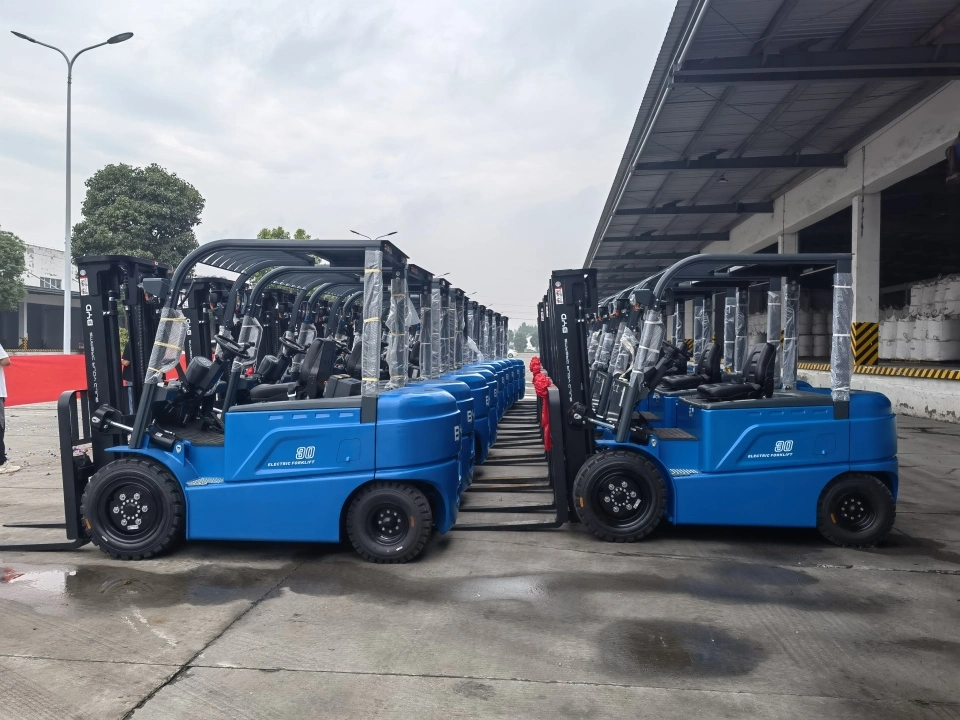
The layout of control levers on conventional forklift units is a foundational element that directly influences operator efficiency, safety, and overall workflow productivity. Standardized across most traditional models, these layouts are crafted with consistent ergonomic principles and intuitive operational logic to minimize learning curves and reduce the likelihood of human error during routine tasks.
At the core of the control layout is the primary operating zone, typically located within easy reach of the operator’s dominant hand, usually the right side of the cockpit. Here, you’ll find levers dedicated to core material handling functions: the lift lever, tilt lever, and in some models, a side-shift lever. These levers are positioned based on operational frequency—with the lift and tilt levers placed closest to the operator, as they are used most frequently during lifting, stacking, and unloading tasks. The intuitive movement logic applies here: pushing the lift lever forward raises the forks, while pulling it back lowers them; similarly, tilting the lever forward tips the mast toward the load, and pulling back tilts it away, aligning with natural operator instincts to avoid confusion.
On the left side of the cockpit, operators will find secondary control levers and switches that support auxiliary functions. This area typically houses the steering wheel, parking brake lever, and controls for lighting, horn, and in some cases, hydraulic system adjustments. The placement of these controls ensures the operator can access them without shifting their core posture, reducing muscle strain during long shifts. Ergonomic design also extends to the physical properties of the levers—they are shaped to fit comfortably in the hand, with a moderate resistance level that requires minimal force to operate, further reducing operator fatigue.
Safety is a key consideration in every aspect of the control lever layout. Most conventional forklifts feature lockout mechanisms for critical levers, preventing accidental activation when the forklift is stationary or not in use. Emergency stop buttons are positioned in a highly visible, easily accessible location, usually near the center of the control console, allowing operators to halt all operations instantly in case of a hazard. Additionally, control levers often have distinct shapes or color-coded markings to help operators identify functions quickly, even in low-light or high-noise environments where visual focus may be limited.
Adhering to this standardized layout reference offers multiple benefits. For new operators, it reduces training time, as they can transfer their knowledge across different conventional forklift models. For experienced operators, the consistent layout minimizes the risk of accidental misoperation, enhancing overall workplace safety. Regular inspection of control levers to ensure they function smoothly and remain in their intended positions is also essential to maintaining optimal performance and safety standards.