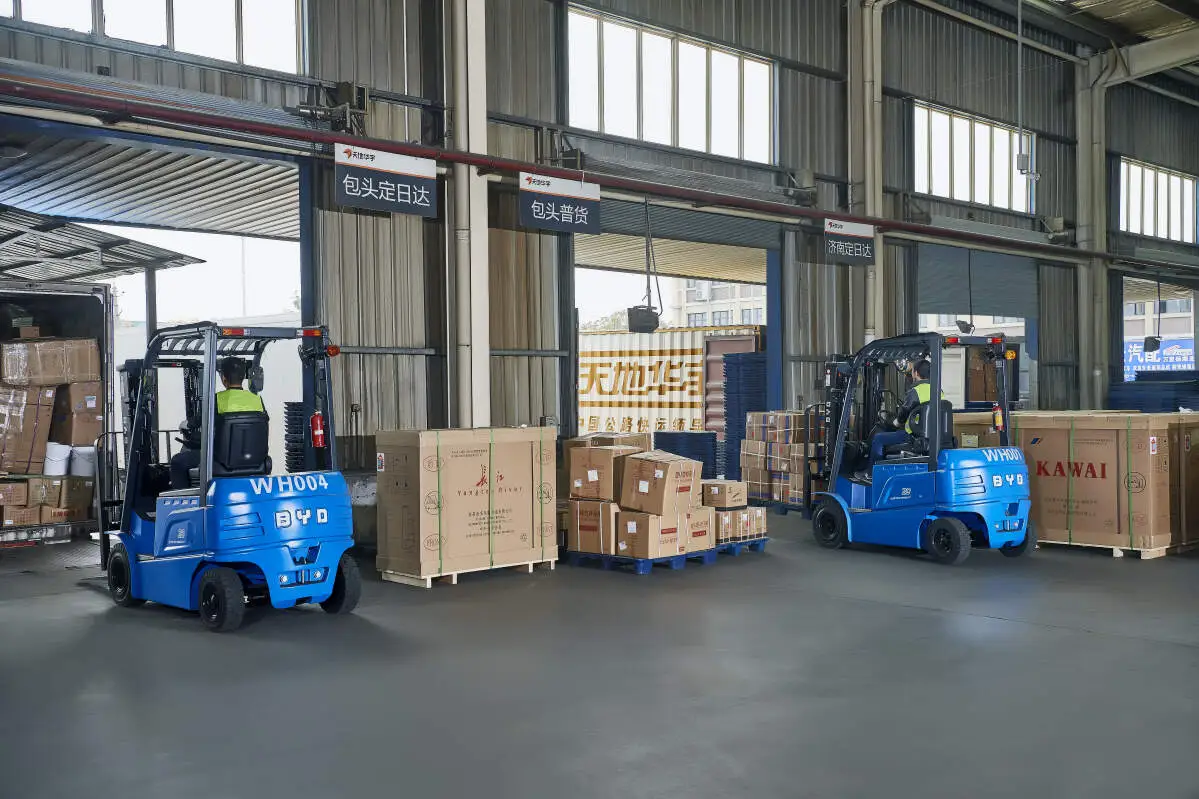
In modern warehouses, distribution centers, and manufacturing facilities, space is often a premium resource. Operations frequently take place in narrow aisles, congested loading docks, and confined storage areas where traditional forklifts may struggle to navigate. This is where rear-wheel steering forklifts come into play, offering unique maneuvering capabilities that address the challenges of tight working environments.
Unlike front-wheel steering models, rear-wheel steering forklifts direct their rear wheels to change direction. This design shifts the turning pivot point closer to the vehicle’s center, resulting in a significantly smaller turning radius. For instance, in an aisle just slightly wider than the forklift itself, a rear-wheel steering unit can make sharp turns without encroaching on adjacent racks or storage—a feat that would be difficult or impossible with standard front-steering alternatives. This precision allows operators to navigate through tight gaps with confidence, reducing the need for extra clearance that wastes valuable space.
Enhanced maneuverability directly translates to better space utilization. Warehouses can optimize their storage layouts by narrowing aisle widths, allowing for more racking systems and increasing overall storage capacity. Without the requirement for wide turn clearances, businesses can make the most of every square foot of available space, cutting down on operational costs associated with facility expansion or additional rental space. This efficiency is especially beneficial for small to mid-sized operations where space constraints often limit growth potential.
Safety is another critical advantage of rear-wheel steering forklifts in tight spaces. The risk of collisions with racks, inventory, or personnel rises significantly in confined areas, but these forklifts offer improved control and visibility for operators. The front end follows a more predictable path during turns, letting operators maintain better awareness of their surroundings. Additionally, the precise steering allows for smoother positioning when loading or unloading pallets, reducing the chance of damaging goods or equipment. This not only lowers replacement costs but also minimizes downtime caused by accidental incidents.
Rear-wheel steering forklifts are particularly well-suited for industries where space is at a premium. Small-scale warehouses, urban distribution hubs, and manufacturing plants with compact work areas all benefit from their agile design. They shine in operations that involve frequent direction changes, such as order picking in narrow aisles or navigating around stacked inventory in busy storage zones. Even in loading docks where space is limited by trucks and other equipment, these forklifts can maneuver efficiently to move goods between vehicles and storage areas.
As businesses continue to prioritize efficiency and space optimization, rear-wheel steering forklifts have become an essential tool in material handling operations. Their ability to navigate tight spaces with ease, coupled with improved safety and enhanced space utilization, makes them a valuable investment for any operation looking to boost productivity and reduce costs in confined working environments.