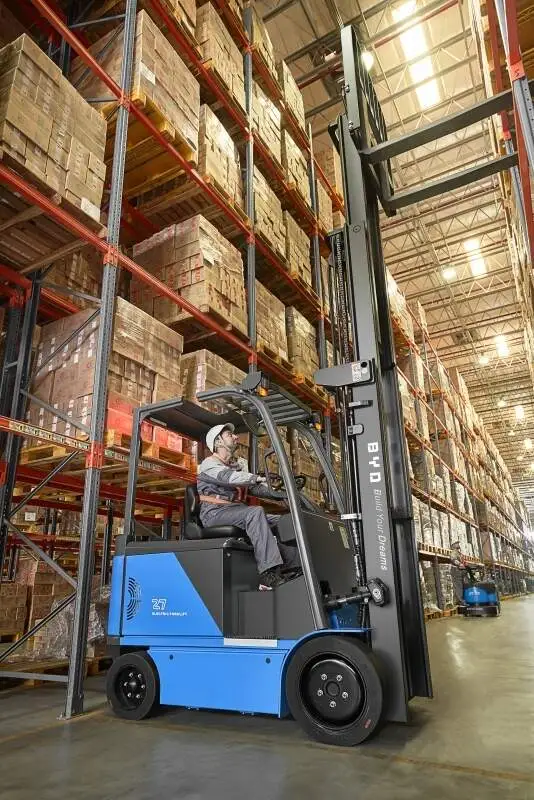
In today’s fast-paced warehouse and logistics environments, the demand for material handling equipment that can navigate tight spaces and adapt to diverse tasks has driven significant advancements in omnidirectional forklift design. Unlike traditional forklifts limited to forward and reverse movement, modern omnidirectional models rely on specialized structural features to deliver enhanced maneuverability and operational efficiency.
The foundational structural element of modern omnidirectional forklifts is their advanced drive chassis. Equipped with omnidirectional wheel systems, the chassis enables smooth movement in any direction—including lateral shifts and diagonal traversal. This design eliminates the need for a large turning radius, allowing the forklift to operate efficiently in narrow aisles and congested areas where traditional models would struggle. The chassis is also engineered with reinforced undercarriages to support consistent weight distribution, ensuring stability during high-speed movements or when carrying heavy loads.
Another key structural characteristic is the compact, lightweight frame. Manufacturers utilize high-strength, low-weight alloys to construct the main body, reducing overall vehicle mass without compromising durability. This compact design not only enhances maneuverability but also lowers energy consumption, extending battery life for electric models. The frame is often optimized with streamlined contours to minimize space occupancy, making it easier to navigate around pallet racks, storage bins, and other warehouse obstacles. Additionally, critical components like batteries and hydraulic systems are strategically integrated into the frame to maintain a low center of gravity, further improving stability.
Load balancing systems are integral to the structural design of modern omnidirectional forklifts. These systems include dynamic counterweight mechanisms and hydraulic load sensors that adjust in real time based on the weight and position of the load. When lifting heavy items, the system automatically redistributes weight to prevent tipping, ensuring safe operation even at maximum lift heights. Some models also feature adjustable fork positions that can be widened or narrowed to accommodate different pallet sizes, enhancing versatility without requiring additional equipment.
Adaptive operational components further define the structural design of these forklifts. Integrated sensor systems are mounted on the frame and chassis to detect obstacles, measure aisle width, and monitor load stability. These sensors work in tandem with the forklift’s control system to adjust movement speed and direction automatically, reducing the risk of collisions and improving overall safety. Additionally, ergonomic operator cabins with adjustable seating and intuitive control layouts are seamlessly integrated into the overall structure to enhance operator comfort and reduce fatigue during long shifts.
In summary, the structural design characteristics of modern omnidirectional forklifts are tailored to meet the evolving needs of modern material handling operations. From maneuverable chassis and compact frames to advanced load balancing systems and adaptive components, these features work together to deliver efficient, safe, and versatile performance in even the most challenging warehouse environments.