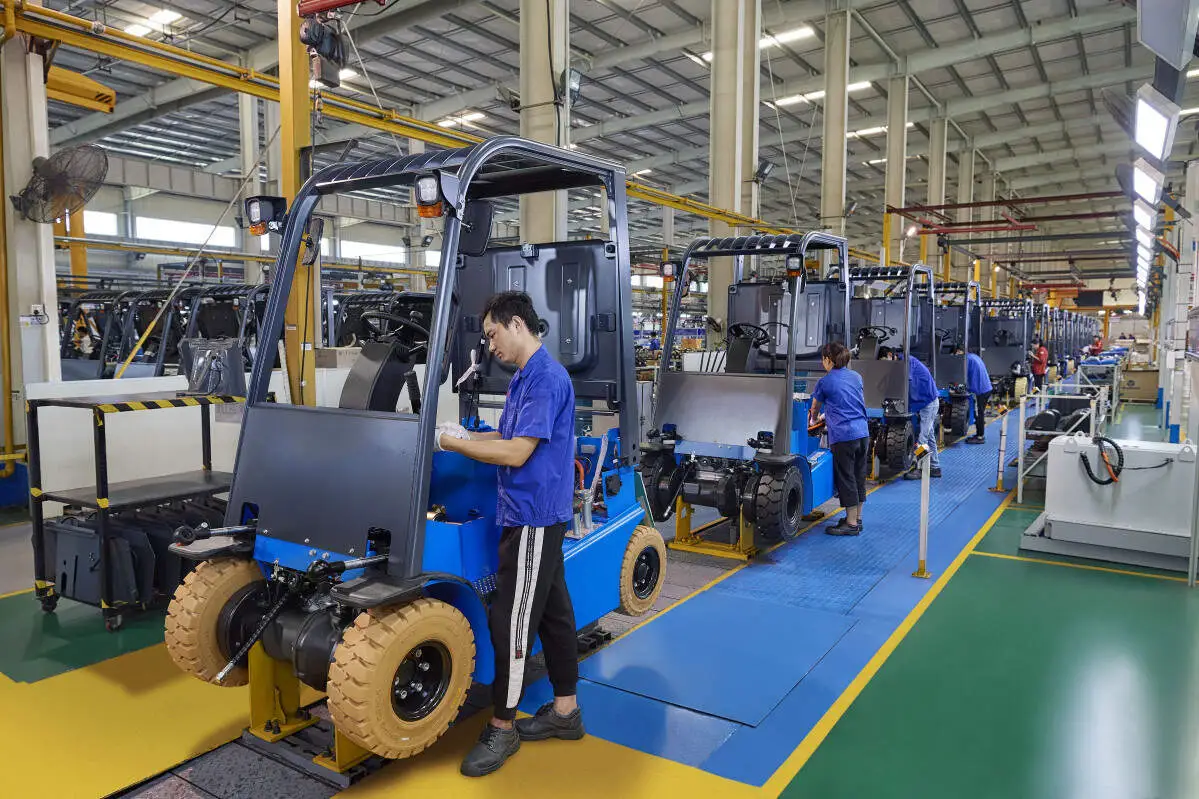
Counterbalance structures are the cornerstone of standard electric forklift units, enabling safe and efficient material handling across warehouses, manufacturing facilities, and logistics hubs. Unlike specialized forklift designs that rely on outriggers or attachments for stability, counterbalance forklifts integrate a dedicated weight component at their rear to offset the torque generated by loaded forks at the front. This design eliminates the need for external stabilizing equipment, making these forklifts versatile for a wide range of indoor and outdoor applications.
At its core, the working principle of the counterbalance structure revolves around torque equilibrium. When a forklift lifts a load using its front-mounted forks, the weight creates a clockwise torque around the front axle. The counterweight, typically constructed from dense, durable materials, generates an opposing counterclockwise torque around the same axle. For the forklift to remain stable, this counter torque must equal or exceed the load-induced torque, effectively preventing the vehicle from tipping forward. This equilibrium is carefully calibrated during the design phase, with engineers taking into account factors like maximum load capacity, lift height, and the forklift’s own weight distribution to ensure optimal performance across various operating scenarios.
Standard electric forklifts rely on battery-powered electric motors to drive both the travel mechanism and the hydraulic lifting system, and the counterbalance structure works in seamless tandem with these systems to maintain stability during all operations. When the hydraulic system raises the forks, the load’s center of gravity shifts upward, increasing the risk of tipping. The counterweight’s strategic positioning and mass are engineered to counteract this shift, ensuring that the forklift’s overall center of gravity stays within the boundaries of the safe stability triangle defined by the front and rear wheels. Even during turns or when navigating uneven terrain, the counterbalance structure helps distribute weight evenly across the vehicle’s base, reducing the likelihood of lateral tipping and enhancing operational safety.
Proper operation of counterbalance electric forklifts requires a solid understanding of this underlying principle. Operators must strictly adhere to load capacity limits and avoid overloading, as exceeding the rated weight can disrupt the delicate torque balance and lead to dangerous accidents. Additionally, adjusting lift heights within recommended ranges helps maintain stability, as higher lifts extend the load’s moment arm and increase the torque exerted on the front axle. Regular maintenance of the counterbalance structure, including inspections of weight integrity and mounting components, is essential to preserve its effectiveness over the lifespan of the forklift.
If you’re seeking reliable standard electric forklift units equipped with optimized counterbalance structures, Jianshu New Energy specializes in BYD electric forklifts, offering solutions tailored to diverse material handling needs. Our team of experienced forklift experts can provide detailed guidance on selecting the right unit, operating it safely, and maintaining its performance over time. For further inquiries or to learn more about our offerings, please reach out to us via email at 17399989919@163.com.