


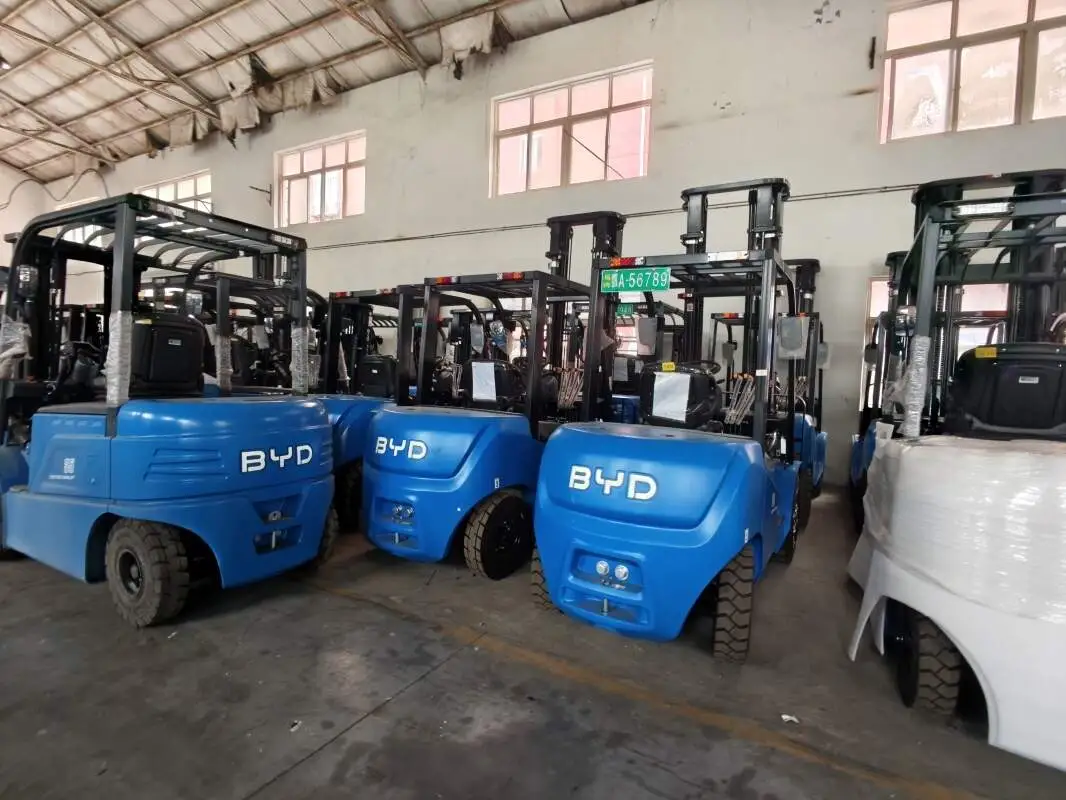
In modern warehouse and logistics operations, electric material handling equipment plays a critical role in streamlining workflows, reducing manual labor, and improving efficiency. Two widely used tools are electric pallet jacks and electric stacker forklifts, each designed to meet specific operational needs. While both serve to move heavy loads, their distinct features make them suitable for different tasks. Understanding these differences is essential for businesses to select the right equipment and optimize their daily operations.
One of the most significant differences lies in lifting height and load capacity. Electric pallet jacks are primarily designed for horizontal load movement rather than vertical lifting. Their lifting mechanism typically raises pallets just enough to clear the ground, usually between 100mm and 200mm. This limited height makes them ideal for transporting pallets across flat surfaces, such as from a loading dock to storage areas or between workstations. In terms of load capacity, most electric pallet jacks can handle weights ranging from 1.5 to 3 tons, with some heavy-duty models supporting up to 5 tons.
Electric stacker forklifts, by contrast, are built for vertical lifting and stacking tasks. They feature a mast system that can lift pallets to much greater heights, often ranging from 3 meters to 6 meters or more, depending on the model. This capability allows them to place pallets onto high shelves or retrieve items from elevated storage racks. Their load capacity is comparable to many electric pallet jacks, typically between 1.5 and 3 tons, though some specialized models can handle heavier loads for specific industrial applications.
Core functionality and ideal application scenarios further distinguish these two pieces of equipment. Electric pallet jacks excel in short-distance, high-frequency horizontal transportation. They are commonly used in retail backrooms, small warehouses, and distribution centers where loads need to be moved quickly between points without requiring vertical storage. Their compact size makes them easy to maneuver in tight spaces, such as narrow aisles or crowded loading areas. Many electric pallet jacks are also designed for ease of use, with intuitive controls that require minimal training for operators.
Electric stacker forklifts, on the other hand, are tailored for tasks that involve vertical storage and retrieval. They are indispensable in warehouses with high-rise racking systems, where efficient use of vertical space is a priority. Stackers can also be used for loading and unloading goods from trucks when elevated access is needed, bridging the gap between ground-level transport and high-shelf storage. Some models even come with features like adjustable forks or tilt mechanisms to improve load stability during lifting and stacking operations.
Maneuverability and space requirements are another key area of difference. Electric pallet jacks are lightweight and compact, with a small turning radius that allows them to navigate through narrow aisles and tight corners with ease. This makes them perfect for facilities with limited space or complex layouts where larger equipment might struggle to operate. Their low profile also means they can be stored in small areas when not in use, saving valuable warehouse space.
Electric stacker forklifts, while still more compact than traditional counterbalance forklifts, are larger and less maneuverable than electric pallet jacks. Their mast system adds height and weight, requiring more space to turn and operate safely. As a result, they are better suited for warehouses with wider aisles and open storage areas where they have room to maneuver without obstructing other operations. Operators of electric stacker forklifts may also need additional training to handle the vertical lifting mechanisms and ensure safe operation at height.
Energy efficiency and maintenance needs also vary between the two. Both electric pallet jacks and stacker forklifts are powered by rechargeable batteries, offering eco-friendly alternatives to gas-powered equipment. However, electric pallet jacks have simpler mechanical structures with fewer moving parts, which translates to lower maintenance requirements and costs. Their batteries are also often smaller, requiring less frequent charging for short-distance tasks.
Electric stacker forklifts, with their more complex mast and hydraulic systems, may require more regular maintenance to keep the lifting mechanisms in good working order. Their larger batteries are designed to support the energy demands of vertical lifting, so they may need longer charging times or more frequent battery replacements depending on usage intensity. That said, advancements in battery technology have improved the efficiency and lifespan of both types of equipment in recent years.
In conclusion, electric pallet jacks and electric stacker forklifts are both valuable tools for material handling, but they serve distinct purposes. Electric pallet jacks are the go-to choice for short-distance horizontal transport in tight spaces, while electric stacker forklifts are essential for vertical stacking and high-shelf storage tasks. By evaluating factors like lifting height, load capacity, application scenarios, and space constraints, businesses can make informed decisions about which equipment to invest in, ensuring optimal efficiency and productivity in their warehouse operations.

