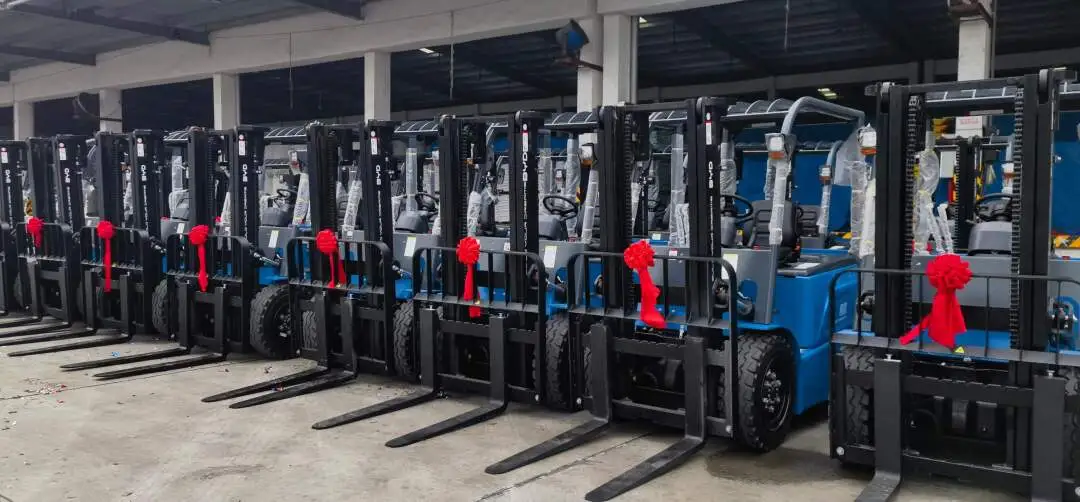
In many industrial settings, low-clearance workshop spaces pose a persistent challenge for material handling operations. Older manufacturing facilities, underground storage areas, and retrofitted industrial buildings often feature ceiling heights, overhead pipes, or structural beams that limit the movement and lifting capabilities of standard forklifts. For businesses operating in these environments, finding a material handling solution that balances compactness with sufficient lifting range is critical to maintaining operational efficiency.
The three-stage telescopic forklift mast emerges as a tailored solution to this problem. Unlike traditional two-stage masts, which have a fixed collapsed height that may exceed low-clearance limits, the three-stage design incorporates nested telescopic sections that retract to a significantly lower profile. When fully collapsed, the mast sits closer to the forklift’s chassis, allowing the entire vehicle to navigate under low ceilings, overhead obstacles, and through narrow doorways without risk of collision.
Beyond its compact collapsed form, the three-stage telescopic mast offers impressive lifting flexibility. When extended, it can reach heights comparable to many two-stage masts, enabling operators to access upper storage racks or elevated workstations even in spaces where vertical clearance is limited during movement. This dual capability—low-profile navigation and extended lifting range—makes it an ideal choice for workshops where operators need to move between tight, low-clearance areas and perform high-lift tasks.
Another key advantage of the three-stage telescopic mast is its structural stability. The nested section design distributes load weight evenly across the mast components, reducing sway and vibration when lifting heavy materials at maximum height. This stability not only enhances operator safety but also minimizes the risk of damage to goods and workshop infrastructure. Additionally, the telescopic mechanism is engineered for smooth operation, with precision-guided sections that extend and retract without jitter, ensuring consistent performance during daily use.
For businesses with low-clearance workshop spaces, the applications of a three-stage telescopic forklift mast are diverse. In manufacturing workshops with overhead conveyor systems or low-hanging utility lines, the mast allows forklifts to maneuver freely while still lifting raw materials to production lines on elevated platforms. In underground storage facilities, where ceiling heights are inherently limited, it enables efficient stacking of inventory on upper shelves without sacrificing storage capacity. Even in small-scale warehouses with mezzanine levels, the mast provides the flexibility to move goods between ground-level loading zones and elevated storage areas.
To maximize the performance and lifespan of a three-stage telescopic forklift mast, regular maintenance is essential. Operators should inspect the mast’s telescopic sections, hydraulic lines, and guide rails daily to check for signs of wear, damage, or leaks. Proper lubrication of moving parts helps reduce friction and ensures smooth extension and retraction. Additionally, operators should receive specialized training to understand the mast’s operational limits, including how to adjust lifting speeds based on load weight and clearance height, to avoid accidents and optimize efficiency.
In conclusion, the three-stage telescopic forklift mast addresses the unique challenges of low-clearance workshop spaces by combining a compact collapsed profile with extended lifting capabilities. Its stable design, flexible operation, and adaptability to diverse industrial environments make it a valuable investment for businesses looking to enhance material handling efficiency without compromising on safety or functionality. Whether navigating under low ceilings or lifting goods to elevated storage, this mast design offers a practical solution that aligns with the needs of modern industrial operations.