
 简体中文
简体中文 繁体中文
繁体中文 Deutsch
 日本語
日本語 한국어
한국어 Tiếng Việt
 Русский
 ไทย
ไทย Bahasa Indonesia
 Bahasa Melayu
 Filipino
 لالعربية
 Français

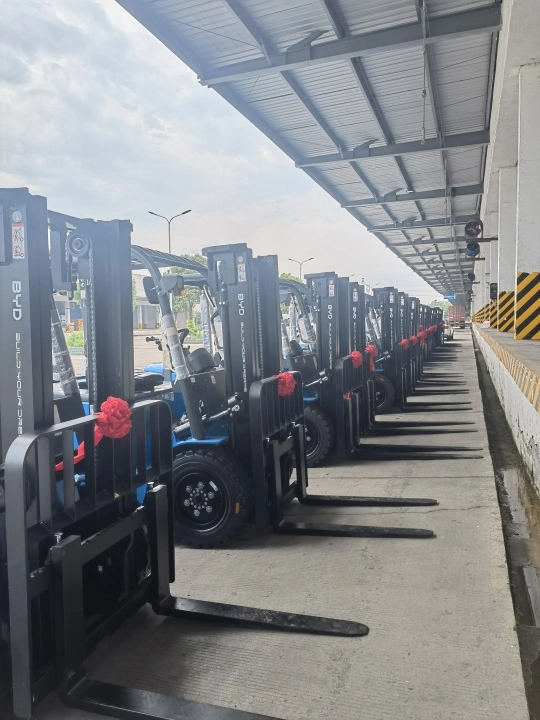
In the warehousing industry, some scenes with limited space, such as high-rise shelves and three-dimensional warehouses, intensive storage of auxiliary materials, etc., require high channel adaptability of operating equipment. As one of the equipment suitable for such scenarios, the legless front-moving lithium-ion forklift shows some practical characteristics in the operation.
Let's start with the channel width adaptation. Ordinary counterweight forklifts or legged forward forklifts may require a wider channel to meet the front space requirements for steering or cargo access when operating at full load. The design of the legless forward-moving lithium-ion forklift eliminates the bottom support legs, allowing the overall turning radius to be smaller. The minimum channel width required for full-load operation of some models can be controlled within a certain range, which can reduce the occupied area of storage channels compared with ordinary equipment and indirectly improve space utilization.
Steering flexibility is another feature. Leg-less lift trucks typically use fully electric steering, and some models are also equipped with two-way or in-situ steering, which allows the driver to adjust the body position more easily during operation. It is more convenient to turn or turn around, reducing the time for repeated adjustments in narrow passages and improving operation efficiency.
The design of the door frame forward and lift is also suitable for narrow aisle scenarios. During operation, the driver can first bring the body close to the shelf, and then send the fork to the designated position of the shelf through the door frame forward device. After the access is completed, the door frame is retracted, and there is no need to reserve a large front driving space like a counterweight forklift. At the same time, the door frame height of this type of forklift can also meet certain high-rise shelf requirements, helping to realize the combination of dense storage and high-rise pick and place.
In terms of battery life and maintenance, the design of using lithium batteries as a power source also has advantages. Lithium batteries charge relatively fast, and some models support charging at any time. There is no need to wait for the battery to be fully charged for a long time, which can better match the needs of multiple shifts or continuous operations. In addition, the daily maintenance of lithium batteries is relatively simple, and there is no need to regularly replenish water or measure specific gravity like lead-acid batteries, which reduces the time and cost of equipment maintenance.
However, when using a legless reach-type lithium-ion forklift, it is also necessary to pay attention to operating standards, such as controlling the driving speed, ensuring that the door frame is retracted and then moving the body, etc., to avoid affecting the safety of the operation due to improper operation.


