
 简体中文
简体中文 繁体中文
繁体中文 Deutsch
 日本語
日本語 한국어
한국어 Tiếng Việt
 Русский
 ไทย
ไทย Bahasa Indonesia
 Bahasa Melayu
 Filipino
 لالعربية
 Français

With the rapid development of the warehousing industry, intelligent warehousing has become the mainstream trend. As one of the supporting equipment, the stable and efficient docking with the intelligent warehousing system is a key link to ensure the smooth operation of the overall operation. The current mainstream smart warehousing supporting forward-moving lithium-electric forklift docking mainly includes two basic types, one is the docking with the warehousing information system, and the other is the docking with the warehousing hardware equipment.
The docking with the warehouse information system mainly refers to the connection of the forward-moving lithium-battery forklift to the warehouse management system through the on-board end point. The basis of this kind of docking is that the on-board end point has the ability to be compatible with standard protocols, common ones are industrial Ethernet protocols and some general logistics protocols. Before connecting, the warehouse management system needs to set the parameters such as the operation path, the storage location of goods, and the charging demand in advance. The on-board end point receives and executes instructions synchronously, and at the same time transmits the vehicle location, operation status, and power information back to the system to realize two-way data exchange. It is important to note that this type of docking requires advance testing and optimization of the network environment to ensure that a stable signal can be maintained in all corners of the warehouse to avoid the stagnation of operations due to signal interruptions.
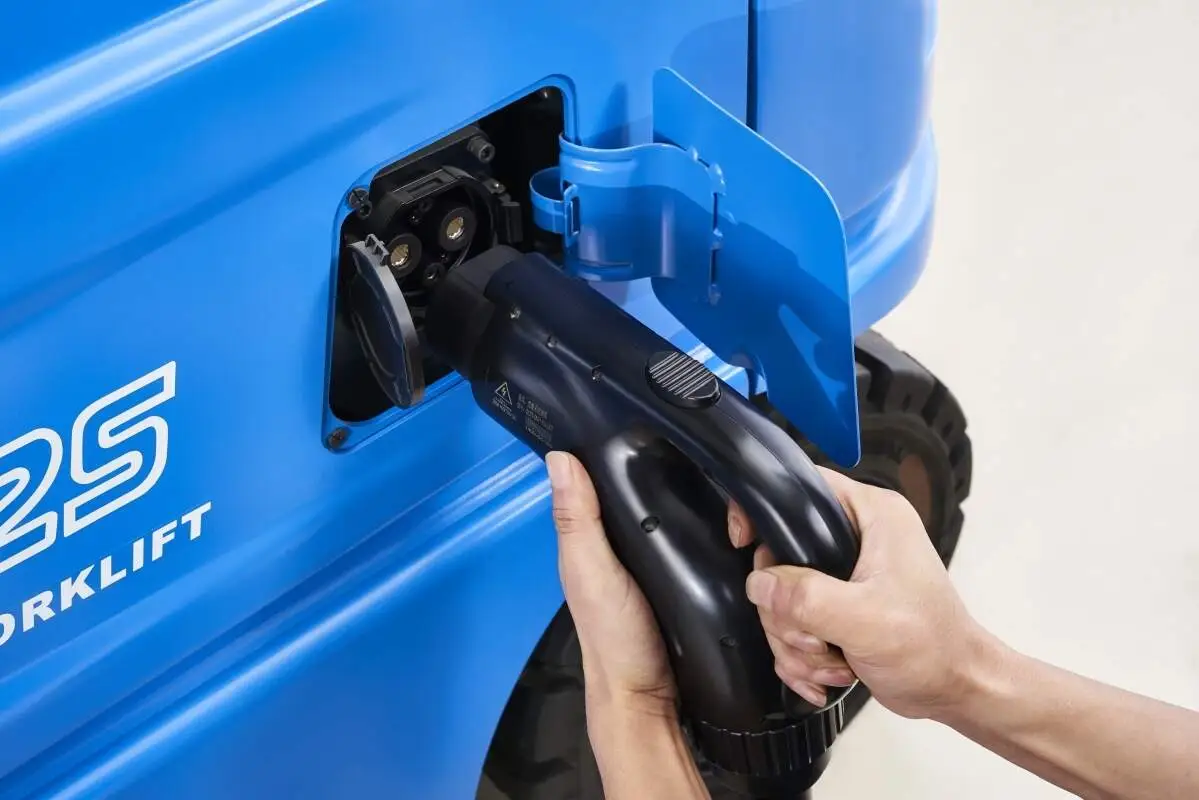
The docking with storage hardware equipment mainly includes automatic charging docking in the charging docking area and cargo handover and docking in the AGV cooperation area. Automatic charging docking is a widely used hardware docking type at present. When the power of the forward-moving lithium forklift is lower than the threshold set by the system, it will automatically plan the path to the charging docking area, accurately locate through the on-board positioning device and the positioning device of the charging interface, complete the docking and start charging. After the power is fully charged, it will automatically return to the job post to continue working. The key point of this type of docking is the control of positioning accuracy, which generally needs to be controlled at the millimeter level to ensure the smooth insertion and unplugging of the charging interface. Cargo handover and docking refers to the transfer and reception of goods by forward-moving lithium-ion forklifts with AGVs, conveyor lines and other hardware equipment. This type of docking also requires accurate positioning and time synchronization to ensure the smooth transfer of goods and avoid goods falling or equipment collisions.
In the docking process of the intelligent storage supporting reach lithium forklift, there are some optimization directions to refer to. First, according to the actual layout and operation process of the warehouse, the parameter settings of the storage information system and the vehicle end point can be adjusted to improve the operation efficiency. Second, the network environment, positioning device, charging interface, etc. can be regularly maintained and maintained to prolong the service life of the equipment and ensure the stability of the docking. Third, the training of operators can be strengthened to make them familiar with the docking process and equipment operation, so as to reduce the problems caused by improper operation.


