
 简体中文
简体中文 繁体中文
繁体中文 Deutsch
 日本語
日本語 한국어
한국어 Tiếng Việt
 Русский
 ไทย
ไทย Bahasa Indonesia
 Bahasa Melayu
 Filipino
 لالعربية
 Français

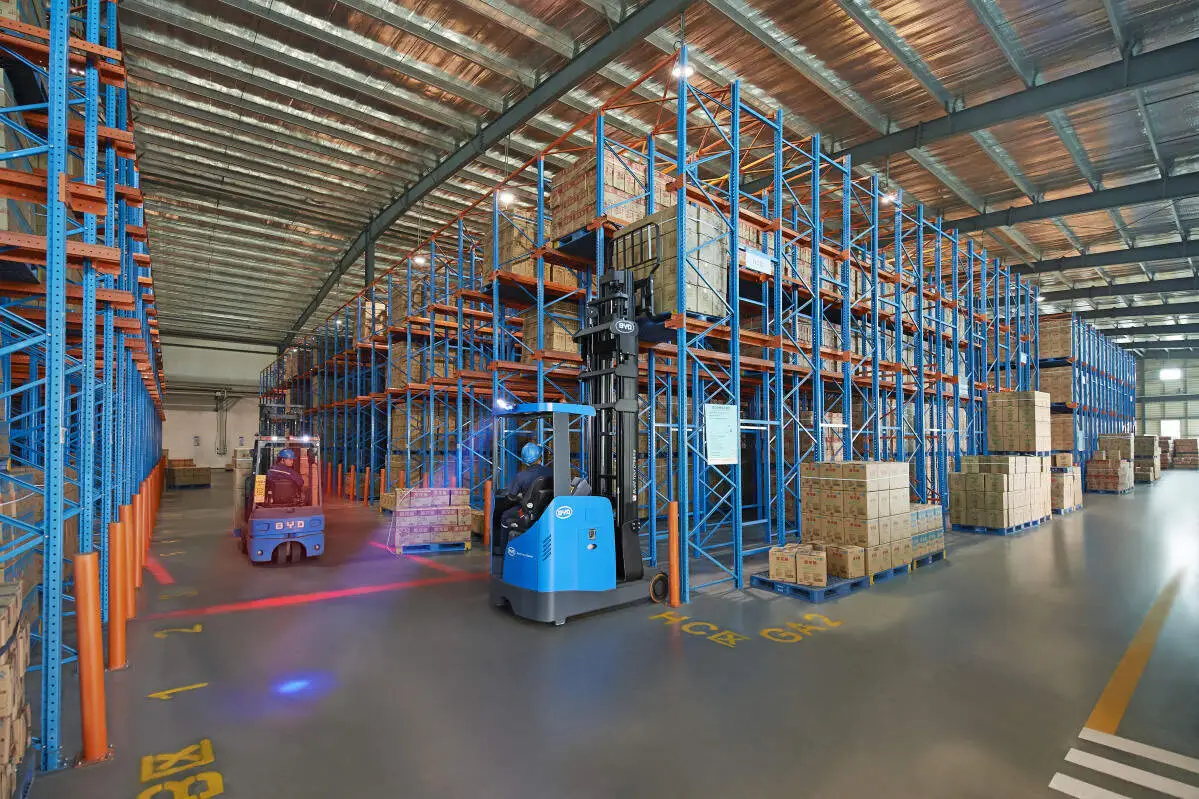
At present, the cost of storage land continues to rise, and it has become an important goal for enterprises to improve space utilization when planning or upgrading warehouses. Reach-moving lithium-ion forklifts are gradually adopted in various storage scenarios due to their characteristics of zero emissions, stable operation, and certain advantages in narrow space operations. Among them, the turning-related parameters of forward-moving lithium-ion forklifts are one of the core basis for determining the channel width and shelf spacing. Reasonable adaptation can avoid traffic hazards, optimize operation routes, and improve overall storage efficiency.
The basic concepts and common parameter types related to the turning of the forward-moving lithium-ion forklift. Before planning and adaptation, two confusing parameters need to be clarified. The minimum turning radius refers to the track circle radius of the most prominent point on the outside of the forklift body rotating around the steering center when the forklift is under no load, the front wheel steering is full to the bottom, and driving at the lowest stable speed. This parameter is a basic reference for measuring the steering flexibility of the forklift, but it cannot be directly equivalent to the channel width between the shelves. The minimum right-angle channel width refers to the minimum shelf spacing when the forklift is under no load, enters the right-angle channel in a straight line and completes the steering and driving out. This parameter is the direct reference for the channel design when the warehouse is planning. It is related to the minimum turning radius, the length of the fork, the width of the body, and the steering method.
The main influencing factors of the minimum right-angle channel width of the forward-moving lithium battery forklift. In addition to the minimum turning radius of the foundation, the length of the fork is the key. The longer the fork, the required channel width during steering will increase accordingly; the width of the vehicle body will also be directly affected, and the too-wide vehicle body requires a larger lateral margin; the difference in steering mode will also bring changes. The steering design of some models can reduce the required channel to a certain extent. In addition, some operating scenarios need to consider the load state. At this time, the channel width needs to be adjusted in combination with the position of the load center of gravity, but most enterprises will reserve a certain safety margin to cover the conventional load.
The key points of adapting the turning parameters of the forward-moving lithium-ion forklift in warehouse planning. First of all, it is necessary to clarify the accurate parameters of the existing or proposed models, which cannot be estimated based on experience alone; secondly, it is necessary to reserve a reasonable safety margin. It is usually recommended to increase the distance of 100 to 200 mm on the basis of the minimum right-angle channel width to avoid scratches in daily operations; again, it is necessary to adjust the overall layout of the warehouse, such as setting the turning area in a relatively spacious position, or adjusting the operation line to reduce the number of right-angle turns; finally, consider the future expansion. If there is a plan to replace longer forks or larger load models, it is necessary to reserve sufficient channel width in advance.


