
 简体中文
简体中文 繁体中文
繁体中文 Deutsch
 日本語
日本語 한국어
한국어 Tiếng Việt
 Русский
 ไทย
ไทย Bahasa Indonesia
 Bahasa Melayu
 Filipino
 لالعربية
 Français

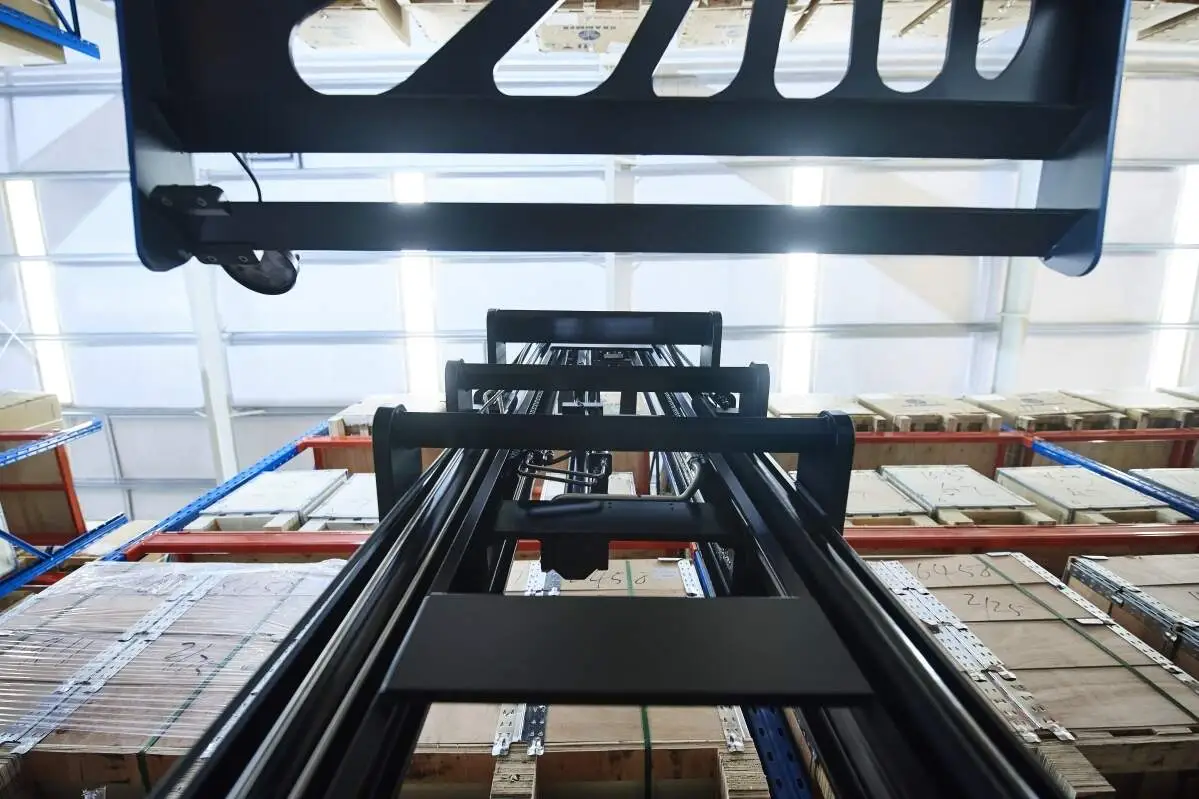
The small turning radius three-point lithium-ion forklift is a commonly used narrow-channel handling equipment in warehousing and distribution, indoor operations and other scenarios. One of its core advantages is the flexible steering ability realized by relying on a specific structure, and the minimum turning radius of some models can even be close to zero. This article briefly introduces the in-situ steering core structure of this type of forklift.
First of all, we need to understand the overall layout of the three-pivot lithium forklift, which is different from the common four-pivot forklift, usually using a "front two and rear one" wheel structure. The two front wheels are used as load-bearing wheels, which mainly carry cargo and body weight, and generally do not bear the active steering function; a single rear wheel is set in the center of the rear side at the bottom of the body, which is both a driving wheel and a steering wheel. This layout is one of the foundations for achieving flexible steering.
One of the key components to achieve in-place steering is the rear axle steering mechanism. This type of mechanism adopts an independent steering drive axle design, integrating the steering motor and the drive motor in the rear axle module. When the vehicle needs to steer in place, the drive motor maintains a stable output or fine-tunes the power according to the steering needs. The steering motor drives the entire rear axle module to rotate 360 degrees around its own vertical axis. The steering angle of a single rear wheel is no longer limited to the small deflection of traditional vehicles, but can achieve nearly complete circular motion. At this time, the midpoint of the front wheel connection of the body is the center of the circle, and the distance to the midpoint of the rear wheel is the radius for rotation. Under suitable operation, a turning radius close to zero can be achieved.
In addition to the rear axle steering mechanism, the synergy of the electronic control system is also essential. The electronic control system will precisely control the speed, torque and steering angle of the steering motor according to the steering instructions of the operator, and coordinate the output of the drive motor to avoid slipping, bumping or insufficient power during the in-situ steering process of the vehicle, ensuring a smooth and safe steering process. Some models will also be equipped with steering angle sensors, position sensors and other components to monitor the steering status in real time, providing data feedback to the electronic control system to further optimize the steering accuracy and response speed.
This in-situ steering structure allows the small turning radius three-point lithium-ion forklift to freely shuttle and turn around flexibly in extremely narrow passages, which greatly improves the utilization rate of storage space, and also reduces the operator's operation difficulty and improves operation efficiency. However, it should be noted that when steering in situ, the vehicle has high friction requirements on the ground, and the ground that is too smooth or oily may affect the steering effect and even bring safety hazards. Before operation, the ground needs to be inspected and cleaned.


