
 简体中文
简体中文 繁体中文
繁体中文 Deutsch
 日本語
日本語 한국어
한국어 Tiếng Việt
 Русский
 ไทย
ไทย Bahasa Indonesia
 Bahasa Melayu
 Filipino
 لالعربية
 Français

The transshipment of goods in the terminal factory usually involves heavier container accessories and bulk pallet materials, which have certain requirements for the load capacity, endurance stability and site adaptability of the forklift. Recently, as an electric forklift practitioner, we followed the transportation team of a port supporting factory and recorded the operation process of a 5-ton lithium-electric forklift for three consecutive day shifts.
At 7:30 in the morning, the transshipment area of the factory has already started to be busy. A 5-ton lithium battery forklift is parked next to the charging station, and the charging gun has been unplugged. According to the driver on duty, this car adopts a design compatible with fast charging and slow charging. After the middle shift ended the day before, about 20% of the power was left. After plugging in the slow charging pile for 8 hours of rest, the power has been fully charged to meet the full load transshipment demand of about 8 hours that day. The fast charging function is mainly used for temporary energy replenishment. Generally, it can support 3 to 4 hours of medium-intensity operation in about 1 hour, which is more suitable for sudden expedited tasks.
The main task of the day was to transport the pallets of metal parts that had just been pulled from the container unloading area to the temporary storage area of the processing workshop about 500 meters away. The total weight of each pallet plus the metal parts is about 4.2 tons, which belongs to the common heavy load range in the factory area. The driver gets into the cab, adjusts the seat and rearview mirror, and starts the vehicle without obvious noise and exhaust emissions, which forms a direct contrast with the internal combustion forklifts used in some parts of the factory area. Although the road in the factory area is hardened, there are occasional small slopes and potholes. The body of this 5-ton lithium-ion forklift is relatively smooth during driving, and the power output is relatively stable when encountering slopes. There is no power interruption.
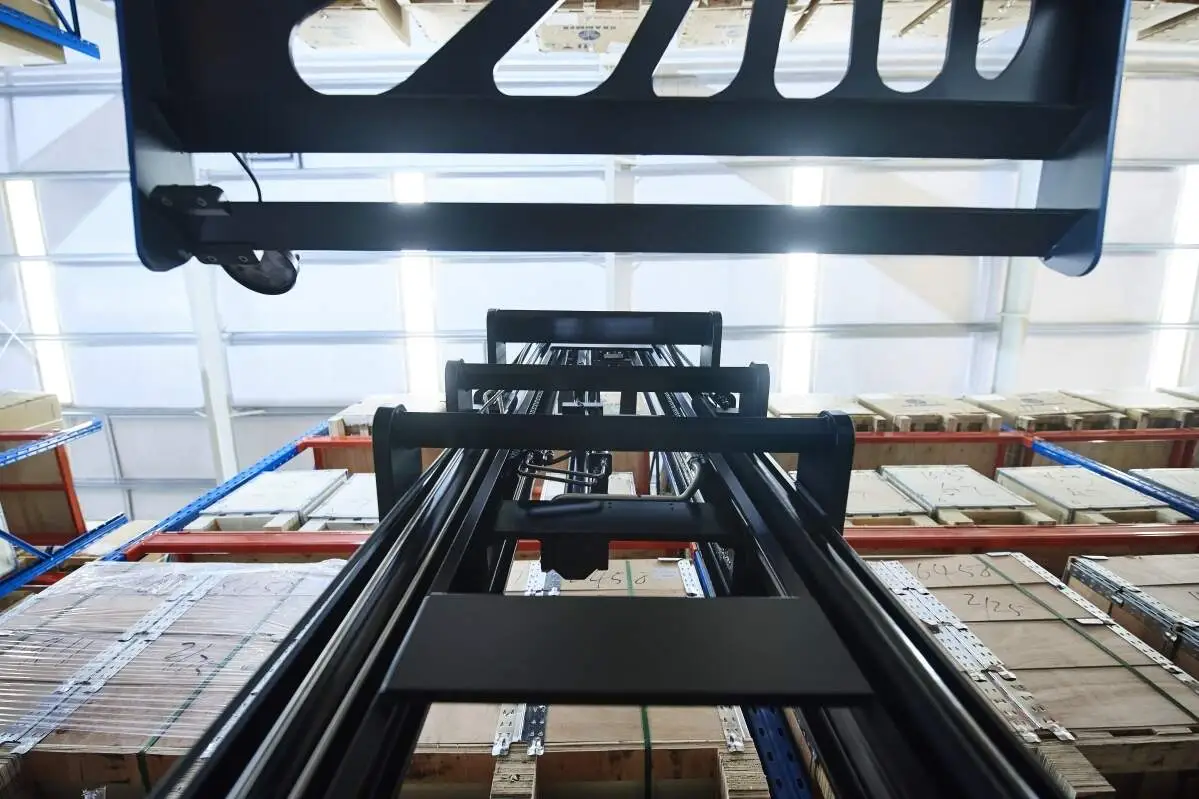
After arriving at the temporary storage area, the driver operated the handle to lift the tray. The entire lifting process was relatively smooth, with no obvious shaking. After lifting to a height of about 3 meters, the tray was smoothly placed on the designated shelf layer. After the whole day shift, the 5-ton lithium-ion forklift completed a total of 42 heavy-duty transshipments, with about 18% of the remaining power, which met the expected battery life performance. The driver also mentioned that the maintenance cost of this car is lower than that of the internal combustion forklift driven before, and there is no need to replace the oil three filters. It only needs to check the tires, brakes, hydraulic system and other conventional components every day.


